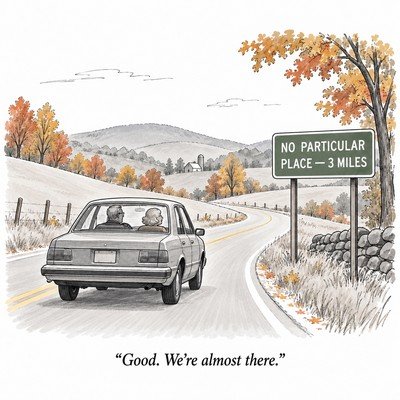
No Particular Place to Go
Embrace early fall in Beaver County with aimless drives, fresh cider, and unexpected discoveries. Adventure awaits just beyond your familiar routes.


Rodger Morrow
Editor & Publisher, Beaver County Business
There was a time when “Where’s the beef?” was a clever question asked by a small, indignant woman in a Wendy’s commercial.
Today it is a question asked by a man standing in front of the supermarket meat case, holding a ribeye and wondering whether the cashier will require cash, credit, or the title to his automobile.
Beef is not cheap. In 2025, retail beef and veal prices rose nearly 12 percent, and the federal government expects them to rise roughly another 10 percent over the course of 2026. Prices have lately begun to ease at the farm and wholesale levels, which is encouraging, although the decline has not yet reached the point where anyone is tossing porterhouse steaks into the shopping cart with the reckless abandon once reserved for potato chips.
The reason is not mysterious. The United States began 2026 with about 86.2 million cattle, the smallest national herd in roughly three-quarters of a century. Years of drought forced ranchers to sell breeding cows because there was not enough grass or affordable hay to feed them. Once a cow is gone, replacing her is not like ordering another floor lamp from Amazon. A heifer retained today will need years before she adds anything wrapped in butcher paper to the national food supply.
There is some relief on the way. More imported lean beef is being allowed into the country, largely for hamburger, and the Department of Agriculture is trying to encourage ranchers to rebuild their herds. But cattle reproduce according to the ancient agricultural calendar, not the expectations of cable television. A government announcement may arrive overnight.
A steer does not.
Even at today’s prices, however, beef deserves a fair hearing.
I admit prejudice. I grew up on a Black Angus farm in Chippewa Township, where the cattle spent their days eating grass and contemplating the same scenery that I did. They were handsome, dignified animals, except when they escaped through a fence and required several adults, a pickup truck, and language unsuitable for agricultural children to persuade them home.
Beef is one of the most concentrated, useful foods with which to feed a family. It provides complete protein, iron in a form the body readily absorbs, vitamin B12, zinc, choline, creatine, and other nutrients rarely mentioned by people selling toaster pastries. A pound of ground beef can become hamburgers, meatloaf, meatballs, chili, stuffed peppers, or the foundation of a casserole designed to get three children and a reluctant husband through Tuesday night.
It is filling, too. Protein and fat tend to keep people satisfied longer than the refined carbohydrates that dominate much of the American diet. A plate of eggs and ground beef may not photograph as prettily as a bowl of cereal decorated with marshmallows in six patriotic colors, but it is less likely to leave you prowling through the pantry an hour later.
This helps explain the popularity of the carnivore diet, which reduces nutritional instruction to something a reasonably alert dog could understand: eat meat.
Some followers report weight loss, steadier energy, fewer cravings, and improvement in digestive or inflammatory symptoms. That may partly be because they have eliminated sugar, seed oils, and ultra-processed food all at once. If a man stops eating doughnuts, frozen pizza, and fluorescent cheese snacks, then feels better after eating steak and eggs, it is possible the steak deserves some credit. It is also possible the absence of fluorescent cheese is doing important work.
The long-term research on an all-meat diet remains thin, and cholesterol can rise sharply in some people. Anyone embarking on it as more than a short elimination experiment should find a physician willing to examine actual laboratory results rather than a social- media influencer willing to examine his own reflection.
Still, the carnivore movement has stumbled onto a useful truth: real food is generally preferable to factory-made foodlike substances. That is also the best part of the Make America Healthy Again movement. Whatever one thinks of its politics, the attempt to steer Americans away from ultra-processed food, unnecessary additives, and chronic childhood illness is overdue. We have spent decades treating brightly colored packages as food and then expressing astonishment when the national metabolism filed a grievance.
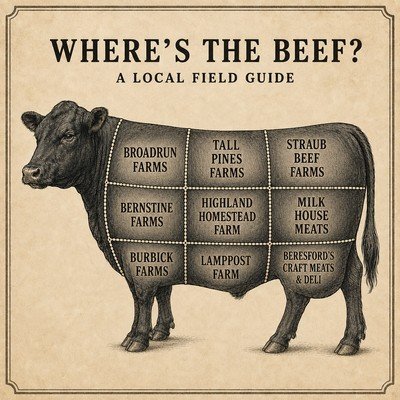
Fortunately, Beaver County families do not have to depend entirely on supermarket beef trucked in from somewhere beyond the horizon. We live within easy driving distance of people who still raise cattle, know what the animals ate, and can tell you where the steak came from without consulting a barcode.
Broadrun Farms in Beaver Falls is a sixth-generation family farm operated by Kevin and Kelly and their family. Its Angus cattle are 100-percent grass-fed and grass-finished, grazing outdoors throughout the year and eating baled forage from the farm’s own pastures during winter. Beef is available by the quarter, half, or whole, with ground beef and other individual cuts sold through the farm’s small retail store. Broadrun also offers organic milk, pastured eggs, cheese, maple syrup, honey, and chicken—enough wholesome food to make the supermarket’s fluorescent middle aisles seem largely ceremonial.
Tall Pines Farms in Darlington is a multigenerational Wagoner family operation. Its cattle are born and raised on the farm, rotationally grazed during the growing season, and finished on hay grown by the family. Tall Pines sells individual cuts as well as halves and whole animals from its farm office on Wagoner Drive.
Also in Darlington, Matt and Jessica Straub operate Straub Beef Farms on about 100 acres. Their cattle graze grass and legumes, and the farm emphasizes careful husbandry
without added hormones. They also raise pork, for those who believe a freezer should encourage denominational diversity.
Bernstine Farms in New Galilee offers 100-percent grass-fed beef and lamb, raised without antibiotics or added hormones. Customers can reserve quarters, halves, or whole animals, and some individual cuts are available online.
Highland Homestead Farm, in the Clinton area, sells pasture-raised beef at farmers markets in Beaver, Ambridge, and elsewhere, as well as through Janoski’s. It is a particularly convenient option for people who want a roast and several pounds of hamburger rather than half a steer staring back at them from the freezer.
For a traditional butcher-shop experience, Milk House Meats on Mercer Road in North Sewickley sources much of its meat from farms within roughly 100 miles. It offers individual cuts, freezer packages, prepared foods, and the increasingly rare pleasure of speaking with someone who knows the difference between a chuck roast and a tenderloin. Ask which current selections are grass-fed or pasture-raised.
A short trip into Columbiana County adds Burbick Farms, where the beef is grass-fed and grain-finished, then dry-aged for tenderness; Lamppost Farm, which raises pastured animals; and Beresford’s Craft Meats & Deli in Calcutta, a quality butcher offering aged beef, custom cuts, and freezer boxes.
Buying a quarter or half directly from a farmer often produces a better average price, although the quoted hanging weight is not the same as the packaged weight that comes home. Ask about processing charges, finishing practices, and freezer space before ordering. A half-beef requires considerably more room than the forgotten bag of peas presently occupying the lower drawer.
The cheapest calorie in America may still come wrapped in plastic and accompanied by a cartoon character. But cheap calories have imposed some very expensive consequences.
Good beef costs money. It also provides protein, nourishment, satiety, and a direct connection to the farms around us. Prices may be beginning to retreat, but the best bargain is not always the lowest price. Sometimes it is knowing the farmer, knowing the butcher, and knowing that what you are feeding your family began as food rather than as a chemistry experiment.
The beef, it turns out, is right here.
Finding the Beef
Broadrun Farms is at 393 Concord Circle Road in Beaver Falls; call (724) 761-4801 or visit broadrundairyfarm.com. Its small farm store is generally open Tuesdays from 5 to 7 p.m. and Saturdays from 2 to 4 p.m. Tall Pines Farms is at 121 Wagoner Drive in Darlington; call Rachel Wagoner at (724) 730-5421 or visit tallpinesfarmspa.com. Straub Beef Farms, also in Darlington, can be reached at (724) 622-4577 or straubbeeffarms.com. For Bernstine Farms in New Galilee, text Ilia at (724) 674-7530 or visit bernstinefarms.com. Highland Homestead Farm can be reached at (412) 908-2654 or highlandhomestead.farm;
its beef is also sold at local farmers markets and Janoski’s. Milk House Meats is at 786 Mercer Road in North Sewickley Township; call (724) 846-0222. Across the Ohio line, Burbick Farms is at 13480 New Buffalo Road in Columbiana, (330) 853-7592; Lamppost Farm is at 14900 Market Street in Columbiana, (330) 531-4240; and Beresford’s Craft Meats & Deli is at 15765 State Route 170 in Calcutta, (330) 385-1162, or beresfordsbutchers.com. Small farms frequently sell out of popular cuts and freezer shares, so call or text before making the drive. Cattle may be patient creatures, but customers in search of ribeyes are not.
Embrace early fall in Beaver County with aimless drives, fresh cider, and unexpected discoveries. Adventure awaits just beyond your familiar routes.

Art’s evolution from craftsmanship to the realm of theory raises questions about value and authenticity, blurring the line between creator and critic.