
The Miller’s Tale
Before Beaver County thrived on steel and glass, its heart lay in the mills that turned grain into flour, connecting farmers and communities through simple…



Rodger Morrow
Editor & Publisher, Beaver County Business
Eva Marie Saint died on October 6th at her home in Los Angeles. She was 102. That is a respectable age for anybody. It is a remarkable one for a woman who spent most of her career declining to become a movie star and became one anyway.
Hollywood likes its legends tidy, so it will remember the Hitchcock picture: the crop-duster, Mount Rushmore, Cary Grant’s suit, and Miss Saint looking as though the State Department had pressed and starched her. It is a fine film. It is also the wrong one.
The right one is “On the Waterfront,” and it ought to be shown in this county more often than it is. The story concerns a union that has stopped belonging to the men who pay its dues. There is a racket that everybody knows about and nobody mentions, and the picture is about what it costs a man to say it aloud. The docks are in Hoboken, but anyone raised along the Ohio between Ambridge and Midland will recognize the furniture.
Beaver County didn’t need Hollywood to teach it this. In the 1930s Jones & Laughlin ran Aliquippa so thoroughly that people called the town Little Siberia. A man who talked union at the wrong lunch counter could be out of work before the shift whistle. J&L fired some of those men, and the case went to the Supreme Court. In 1937 the Court ruled that the Wagner Act meant what it said. A good share of every American worker’s right to organize was won in a mill town a short drive from this office.
The county learned the second half of the lesson more slowly. A union can be won from the company and then lost to its own officers. Every county has had men who knew which questions not to ask, and ours has had its share.
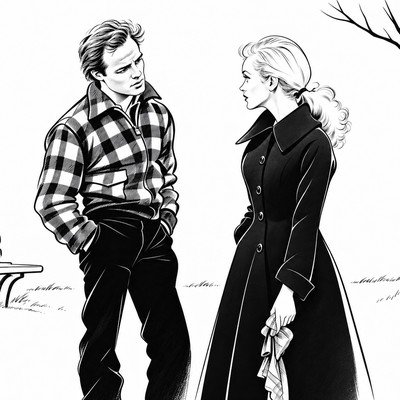
Which brings us back to Edie Doyle. She wants to know who killed her brother, and a man who helped send him to his death is standing in front of her. Marlon Brando plays him with the full Method. In 1954 that meant mumbling as though the truth were stuck in his throat and might come loose if he swallowed hard enough. She doesn’t try to outdo him. She stands there and listens. In the movies that is rarer than talent and harder to fake. At a public meeting in the county it is rarer still.
Kazan had named names before a congressional committee two years earlier, and plenty of people took the picture as his brief for the defense. Edie doesn’t care about any of that. She only wants somebody to tell the truth.
I suspect Kazan wanted a girl who looked as if she might still believe a man who said he was sorry. Studios generally preferred girls who looked as if they had been sorry for a living. Kazan won. What he got was a girl born in Newark and raised in Delmar, New York, who went to Bowling Green to become a schoolteacher like her mother and wandered onto the stage instead. She was thirty and playing a convent schoolgirl, and nobody in the audience thought to object.
When the Oscar came she was very pregnant. She told the audience she might have the baby right there. She didn’t. She waited two days. Hollywood had no idea what to make of a winner who treated the big night as an errand between contractions, so it called her luminous and went back to work.
She stayed luminous, which is the polite word for an actress who keeps turning down pictures. She had a husband, Jeffrey Hayden, for sixty-five years, and a gift for the word “no.” The pale hair did the rest.
People assumed a press agent had invented her name. None had. Eva Marie Saint was what the birth certificate said, which must have been hard on the people whose job was inventing names.
Thirty years after the waterfront, a young Englishman at the university in Glasgow, his head full of other people’s paperbacks, wrote a song about a bookish girl. Lloyd Cole and the Commotions put it on “Rattlesnakes,” and the line that matters compares the girl to Eva Marie Saint in the Kazan picture.
The rest of the verse gives the girl Simone de Beauvoir and some romantic disappointment, which is what young men did in 1984 when they wanted to sound as if they had suffered. Cole wasn’t describing Saint. He was describing the idea of her: the girl who hasn’t yet decided whether the fellow in the plaid jacket deserves her glove back.
That is an odd sort of fame. Most actresses are remembered for a gown, a scandal, or a line they had to say three times before the director was happy. Saint is remembered as a standard of comparison. A songwriter who says a girl looks like her in that picture means nobody has talked the girl out of her better instincts yet. It’s a compliment, and also a job description. Hollywood spent the next fifty years trying to cast that quality and mostly cast the coat.
She worked when she felt like it. She seemed to treat the work as something to do between the more serious business of not becoming ridiculous. There are worse ways to spend a century.
Somewhere Brando is still holding the glove and still trying to explain himself. She is still waiting to see whether he means it.
Before Beaver County thrived on steel and glass, its heart lay in the mills that turned grain into flour, connecting farmers and communities through simple…
Rowetown’s history is a tapestry of community life, where ordinary intersections held significance, now faded yet vital to understanding our past.