The Actress Who Listened
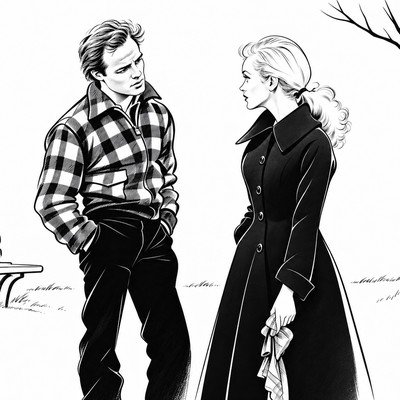
Eva Marie Saint, a Hollywood legend who defied stardom, passed away at 102, leaving behind a legacy defined by authenticity and unwavering integrity.


Rodger Morrow
Editor & Publisher, Beaver County Business
Before Beaver County learned to make steel, glass, and arguments about property assessments, it had to make breakfast. This required a farmer, some grain, and somebody who could persuade running water to turn a very heavy stone. The arrangement lacked the sophistication of the modern food system, in which breakfast comes in a box that explains why you should feel guilty for eating it. It did, however, produce flour.
The miller had an enviable position. Everybody needed him, and he got paid before you got your flour. Lawyers later perfected this system, but the miller, unlike the lawyer, handed you something you could eat.
Beaver County never had one great mill. Its mills followed the streams: Raccoon Creek, the Little Beaver, the Connoquenessing, Brush Creek, and the falls of the Beaver River. A creek that dropped a few feet in a short stretch was the frontier’s idea of a good business address. Nobody cared whether the neighborhood was walkable. They cared whether the wheel would turn.
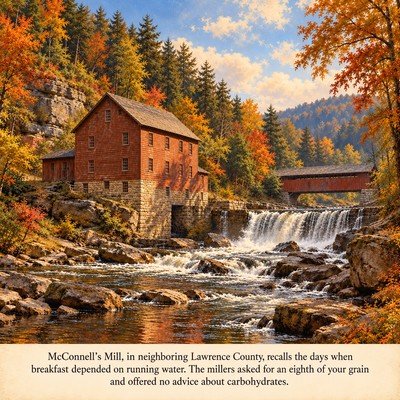
White’s mill, on Raccoon Creek near Potato Garden Run at Murdocksville, is generally considered the first. John White had it running by the late 1780s, before there was a Beaver County to put it in. Its millstones came from France. Even on the frontier, a man who ground grain for a living knew some things were worth sending away for.
The mill ground until 1904. Its log building lasted until about 1950, when souvenir hunters took it apart. It was an early form of historic preservation: everybody saved a piece, and nobody saved the building.
Along the Little Beaver, milling was practically a neighborhood habit. In 1911, Ira Mansfield counted seventy-two flour and grist mills on the stream and its branches, some now in Lawrence County and Ohio. That is a lot of people trying to make a living from water that had somewhere else to go.
At Cannelton, George Foulks built a grain and saw mill in 1797–98 that became Watt’s mill, run by Thomas and James Watt. Its wheel lay flat, a disappointment to anyone who had learned about mills from paintings.
The Watts specialized in buckwheat. Their toll was about one-eighth of the grist, taken in flour, which they sold to the Grand Hotel and restaurants in Beaver Falls. The farmer got his meal, the miller got his inventory, and nobody had to search his pockets for money.
The Watts also had standards. They would not grind buckwheat on a damp day. The customer might be king, but he was not going to tell Tom Watt what damp buckwheat ought to do.
Roads led to the mill, and other business settled beside it: sawmills, wool carding, stores, sometimes a distillery. A farmer who couldn’t afford to haul his corn to market could afford to haul it as whiskey.
The miller knew whose crop was good and who would be short before spring. Where store credit came in, he helped bridge the distance between eating this winter and harvesting next summer. He was no banker. But he knew his customers better than any credit score does.
At the falls of the Beaver, milling outgrew the neighborhood. The Pughs opened a flouring mill at Fallston in 1804. At Brighton, later Beaver Falls, James Patterson bought land in 1829, built a dam and flour mill, and sent his “extra family” flour toward Philadelphia by canal.
Beaver County breakfast had entered the export business.
The Ohio was a highway, not a millrace. At Economy, the Harmony Society skipped the wheel. By 1826 a seventy-five-horsepower steam engine from Pittsburgh drove a complex that included a flour mill, textile works, a brewery, and a distillery, and its exhaust steam heated the workshops.
The Harmonists expected every machine to earn its keep twice. Our appliances are still working on once.
Monaca’s roller mill, established in 1888, pointed to what was coming: bigger machines, bigger markets, fewer millers. The creek mills could not keep up. Steel rollers and western wheat made flour cheaper than any local millstone could. Mansfield found Watt’s still grinding buckwheat in 1911. It burned in 1916.
The rest went by fire, flood, wrecking bar, or neglect. Hazen’s mill on the Connoquenessing was torn down in 1932 after its dam was lost. The millers’ names stayed on the roads.
We still drive those roads, generally to buy bread made somewhere else. The old miller would wonder why we pass the place his mill stood to buy flour that traveled a thousand miles. Then he would look at the price and understand.
What would puzzle him is that nobody at the store knows whose wheat it was, who ground it, or whether the farmer will get through the winter.
We know how many carbohydrates are in a slice. He knew a good deal more about the bread.
Eva Marie Saint, a Hollywood legend who defied stardom, passed away at 102, leaving behind a legacy defined by authenticity and unwavering integrity.
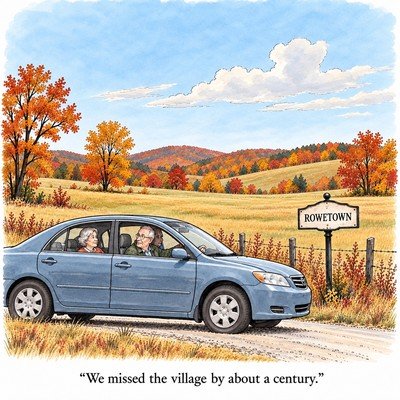
Rowetown’s history is a tapestry of community life, where ordinary intersections held significance, now faded yet vital to understanding our past.