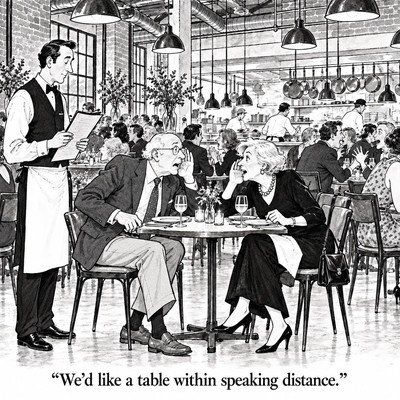
I’ll Have the Special. What Did You Say It Was?
Dining out should be about connection, not chaos. As noise levels rise, so does the challenge of enjoying meaningful conversations over dinner.



Rodger Morrow
Editor & Publisher, Beaver County Almanac
An acre measures sixty-six feet by six hundred sixty feet, a fact I learned long ago and had no use for until now. What you put on it decides whether you end the year with a new tractor or a new problem.
Plant corn and you worry about rain. Graze cattle and you worry about fences. Put up a windmill and the neighbors eventually mention the hum in the checkout line. Put up an AI data center and you acquire a building the size of an airport that has never seen an airplane.
You also acquire neighbors with questions.
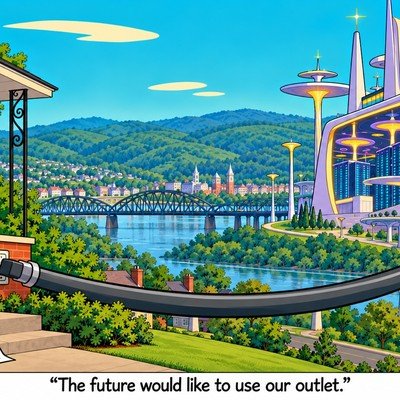
They sound increasingly like the people who once lived beside proposed nuclear plants. When schoolchildren practiced hiding under desks in case somebody overseas pushed the wrong button, grown-ups debated whether to live beside a reactor. Today they debate a windowless box whose chief talent is making electricity disappear. The box does not threaten to glow. It threatens to turn up on the electric bill, which has given the discussion a certain urgency.
Beaver County knows both kinds of building. In 1957, Shippingport became a showpiece of President Eisenhower’s Atoms for Peace: a full-scale nuclear plant making electricity for ordinary customers. It ran for a quarter-century, then was taken apart with the care usually reserved for a grandmother’s china. The neighboring Beaver Valley nuclear station is running still.
Nearby, the old Bruce Mansfield coal plant has gone quiet. Texas-based Aligned is building a data-center campus beside it called Project Phoenix, which is what you name something when you would prefer people to think about rebirth instead of ashes. Aligned says dedicated onsite generation will supply its power and protect local ratepayers. Whether the arrangements deliver what the announcement promises will interest everyone who receives an electric bill.
In Big Beaver Borough, Switch proposes three buildings at the former Pittsburgh International Race Complex, roughly four hundred acres where people once paid good money to drive fast in circles. Residents want to know how much power, how much water, how many permanent jobs, and who pays when an estimate develops ambitions. Switch, too, says it will fund the infrastructure its power needs require. This is welcome language. Residents would like to know how it becomes an enforceable arrangement.
The pattern is familiar. The building is big. Its customers are elsewhere. The neighbors are asked to take the rest on faith, a financing method that works better for the person receiving it.
One early chapter of this business unfolded in a Virginia parking garage. In the commercial internet’s infancy, companies needed places where their networks could exchange traffic. One important meeting place occupied space off a garage on Boone Boulevard in Tysons Corner. The internet was becoming indispensable to civilization a few yards from somebody’s parked Buick.
Once networks gathered, computers followed. Being close to the connections saved time, and on the internet even a fraction of a second can be worth paying for. Northern Virginia became a place where companies put computers because other companies had already put computers
there. Americans recognize this principle from restaurant rows, shopping centers, and the seating arrangements at weddings.
The buildings multiplied. County governments discovered that a windowless box could possess considerable taxable charm.
What has changed is the work inside. A familiar internet task is fetching a movie or photograph that already exists. Generative AI produces an answer, image, or other material in response to a request. Training the models can require immense quantities of computation; running them adds another demand.
The old clerk fetched a file. Management has now engaged a roomful of clerks to compose something, and every clerk wants an electrical outlet.
The water question is more local than the national argument suggests. Some cooling systems evaporate substantial amounts. Others recirculate water or rely heavily on air cooling. A national comparison with farm irrigation tells a borough very little about whether its own supply can spare what a particular building proposes to take.
Aligned says its Shippingport design will use air cooling and a closed water loop, requiring little replacement water after the initial fill. That is a useful detail, and a better starting point than assuming every data center arrives with a drinking straw aimed at the Ohio.
The questions remain ordinary ones: How much? From where? During a drought? Who has checked?
Electricity is harder. A large new customer may require new generation, substations, and transmission lines. Somebody must pay for them. The announcement generally gives more attention to the investment than to the somebody.
If the customer covers the costs it causes, neighboring households have less reason to object. If those costs are spread among other customers, the households help support a business whose users may live in another state or another country. A promise to bring power deserves examination of the fuel supply, backup arrangements, utility agreements, and what happens if the customer leaves.
A ribbon-cutting lasts an afternoon. Infrastructure has a longer memory.
Meanwhile, Three Mile Island, for nearly fifty years the country’s favorite cautionary tale about nuclear power, is being prepared for a restart under a power agreement with Microsoft. This is Unit 1, the reactor that did not suffer the 1979 accident. Symbolism has never had much patience for details.
The circle is nearly closed. Nuclear power, once the unwelcome neighbor, is being recruited to supply the new unwelcome neighbor.
Beaver County has spent generations making things the rest of the country needs. It knows the value of a payroll, a productive site, and a customer for its electricity. It also knows that a large investment and a good bargain are separate questions.
The neighbors are entitled to ask both.
They need not understand artificial intelligence to recognize an old American arrangement: somebody builds a very big thing, announces what it will do for the community, and leaves the community to read the small print.
This time, people would like to read it before the meter starts.
Dining out should be about connection, not chaos. As noise levels rise, so does the challenge of enjoying meaningful conversations over dinner.

November brings contrast: fleeting warmth and impending cold. Amidst the change, gratitude shines through shared moments and warm meals. Enjoy the now.