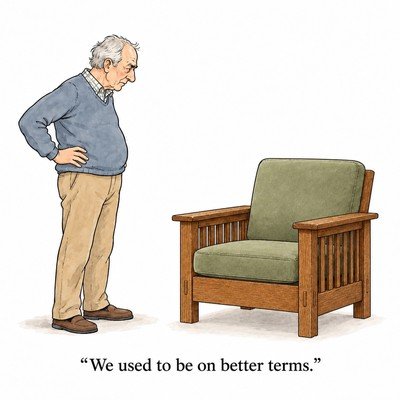
The Chair Problem
Aging brings unexpected challenges, as our bodies require more planning for simple tasks. Embrace strength training and nutrition to reclaim vitality.


Rodger Morrow
Editor & Publisher, Beaver County Almanac
Hollywood had a lot to say about America. Then somebody went out and looked at it.
Rodger Morrow, Editor & Publisher Beaver County Almanac
There was a time, not long ago, when you could turn on the television and feel reasonably sure that nobody on the screen had ever met a cow, a roughneck, or a woman who carried a rifle for a living. The people on the screen were busy becoming better people in Brooklyn, or deciding in glass offices whether their feelings were valid.
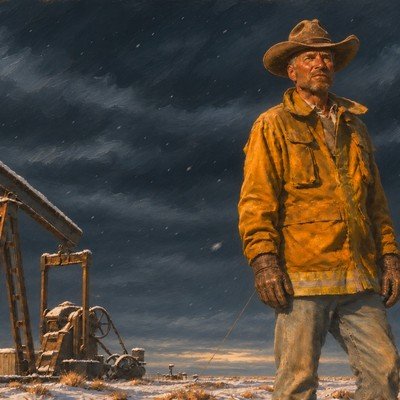
Then Taylor Sheridan came along, and it turned out the country still had an appetite for stories in which the work is hard, the land is particular, and the results don’t care what anybody meant.
He doesn’t make speeches about this. He fills the screen with people who already know it. John Dutton knows that anything worth having will be taken unless somebody defends it. When he becomes governor of Montana, he tells the voters, “If it’s progress you want, then don’t vote for me. I am the opposite of progress. I am the wall it bashes against, and I will not be the one who breaks.”
As campaign slogans go, it is more weather report than promise. His ranch hands wear his brand, which marks both where they belong and what belonging costs.
Tommy Norris, the landman out in the Permian Basin, knows that a wind turbine is not a moral argument. It is a machine. Standing under one with a young lawyer who admires it as clean energy, he runs the inventory: a concrete foundation covering a third of an acre and going down twelve feet, the diesel burned to mix it and to make the steel, a 450-foot crane to stand the thing up, the oil to lubricate it and keep it from freezing. “In its twenty-year lifespan,” he says, “it won’t offset the carbon footprint of making it.” Then he keeps going: cellphone cases, heart valves, tennis rackets, lipstick, soap, garbage bags, fishing boats. “We don’t do it because we like it. We do it ’cause we run out of options.”
The women in Lioness know that the world contains people who mean them harm, and that the agencies assigned to stop those people are often late, distracted, or busy elsewhere. The women drafted into the program don’t come home the same. The work turns intimacy into a tool, splits lives in two, and spends family ties until the personal cost stops being a side effect and becomes part of the job description. China appears as a patient, clever rival that works through proxies and soft spots rather than tanks. Cartels are treated as national-security problems, not police business.
The shows let those judgments come out in the work. They don’t ask the audience to supply the sermon.
This is the part that still surprises some critics. Sheridan’s early films—Sicario, Hell or High Water, and Wind River—were praised for their gray areas and their refusal to balance the moral books. In Sicario the idealistic FBI agent is shouldered aside by an operation using methods she can’t stomach. Near the end, Alejandro tells her, “You should move to a small town where
the rule of law still exists. You will not survive here. You are not a wolf. And this is the land of wolves now.”
It isn’t a threat so much as directions. Sheridan has said the film was less about the drug war than about a consumer nation’s appetite and whether ends justify means.
When the same man went on to make Yellowstone, Landman, and Lioness, some of the same critics found the gray areas still there; they had merely grown sharper edges. The drug war still has no clean ending. The oil field still kills people. The ranch is still besieged by money that doesn’t live there. What changed was Sheridan’s willingness to say that certain popular accounts of these facts had worn thin.
Sheridan has always distrusted big outfits. Banks that foreclose on the people who still know how to fix a fence. Companies that see a valley as a line on a balance sheet. Federal agencies that arrive with rules written for some other landscape. In the later work the list grew. Jargon that treats competence as a problem. Media that prefer a story to a fact. Academics who reach the border or the oil patch already knowing what they’ll conclude.
You don’t have to join a party to recognize any of this. You only have to have watched an institution fail up close and noticed that nobody called it a failure.
The moral bills still come due. The women of Lioness don’t come home unaltered. The men who hold the ranch don’t hold it without becoming harder than they intended. John Dutton tells his son that the only way to deal with certain kinds of evil is to be meaner than it, and still be able to love your family and enjoy a sunrise. The landman doesn’t get to pretend the work is clean. Sheridan has never bought the fantasy that force can be used without leaving damage behind.
What he has lost patience with is the opposite fantasy, that the damage is the only fact worth discussing. A society that can’t name its enemies, or that considers naming them the greater sin, eventually discovers its enemies have been naming it all along.
None of this is exotic in Beaver County. In the late 1980s, after losing their jobs and then their retirement benefits, a group of Aliquippa steelworkers went back to the railroad tunnel at the entrance to the old mill. They went to protest. The city’s history records that when the police came to arrest them, some of the officers had to put handcuffs on members of their own families.
Sheridan’s characters aren’t from here, but they speak a dialect the county knows well: the speech of people tired of hearing that what they know how to do is either nostalgia or a moral failing.
The commercial success has produced its own irony. A Hollywood that spent years explaining why stories about rural skill, military necessity, and the realities of energy were narrow or backward discovered that a great many Americans would happily watch such stories by the season. Sheridan didn’t invent this audience. He noticed it standing there, neglected by people who preferred their America more abstract.
That he is himself a rancher with a good deal of land doesn’t disqualify the point. It only makes it more expensive to dismiss.
He still insists that good storytelling shows more than one side. The Native characters in Yellowstone aren’t scenery; Thomas Rainwater’s claim on the land carries weight even as the
Duttons defend theirs. The cartel violence in the Sicario films isn’t tidied up. The personal wreckage in Lioness isn’t waved away. What has grown harder to sustain is the old critical reflex that treats any defense of borders, energy production, or skepticism of institutions as disqualifying on its face.
The reflex survives. It just commands less of the audience than it used to. Sheridan’s shows didn’t cause that shift. They arrived about the time it became hard to ignore, and gave it faces and a landscape.
A columnist isn’t obliged to declare Sheridan right about every detail. The wind-turbine speech can be argued with on engineering grounds, and engineers have. The precise relationship between cartels and terrorism can be parsed. The Duttons’ methods wouldn’t survive ten minutes with a county solicitor.
Nobody is required to live inside one man’s television universe. Most of us already live inside the limits the shows put on screen: the price of fuel, the reliability of the grid, the skill of whoever shows up when something breaks, the distance between a rule written in one place and the ground it lands on in another. Sheridan’s particular service has been to treat those limits as fit subjects for popular storytelling rather than as obstacles to be overcome by better attitudes.
Along the way he has made a great deal of money and irritated a fair number of people who preferred the attitudes.
The irritation is useful. It marks the line between an America that can still tell a necessary job from a symbolic one and an America that has come to think the distinction optional. The line isn’t neat, and Sheridan’s characters cross it in both directions, usually at a price. The shows don’t settle the matter. They simply decline to pretend the price is abstract.
For a county that has paid more than its share of abstract prices over the last forty years, that is not nothing. The conversation had been waiting for somebody willing to have it on television, of all places.
Aging brings unexpected challenges, as our bodies require more planning for simple tasks. Embrace strength training and nutrition to reclaim vitality.

As Switch plans a data-center campus at the old Big Beaver racetrack, questions arise about who pays if the project underdelivers on power needs.