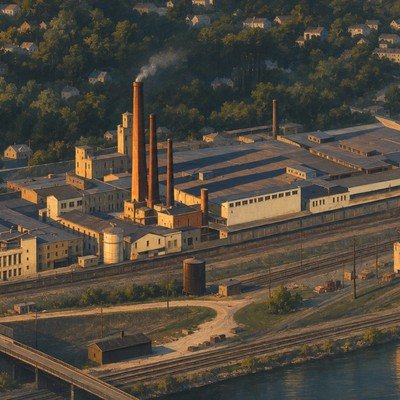
A Man Needed Two Shirts – How Armstrong Cork Made a Business Out of Leftovers in Beaver Falls
Geneva College’s football Saturdays once featured a relic of industry, blending nostalgia with the thrill of the game amidst Beaver Falls’ rich history.



Rodger Morrow
Editor & Publisher, Beaver County Almanac
One of the quieter pleasures of motor racing was that nobody sent the grandstand a bill. A driver could leave his transmission in pieces on the back straight, and the spectators went home owing nothing to anybody except possibly the hot-dog vendor.
Now Switch proposes a data-center campus on the old Big Beaver racetrack. Suppose the electric company spends heavily getting ready for it, and the project turns out to want less electricity than expected. Who gets the bill?
At its October presentation to the Big Beaver Planning Commission, Switch said it would pay the full cost of delivering power to the campus and that rates would not be affected. Power would come through the existing Hoytdale switching station. The plan calls for three buildings of roughly 215,000 square feet apiece, with room for two more.

This is a handsome promise to anyone who has opened an electric bill lately and wondered what the company would charge if it knew how much we love the refrigerator. I’d like to see it in the agreement with the utility. A slide has room for “100 percent.” A contract has room to say 100 percent of what, payable when, and by whom if the signer runs short of cash. Slides are written by optimists; contracts are written by people who have read a few slides.
The Nov. 9 MarketWatch newsletter rounded up Wall Street’s troubles: an Nvidia board investigation involving its chief executive, investors questioning the timing of Anthropic’s initial public offering, and earnings due Tuesday from CoreWeave, a heavily borrowed renter of computing power. The people whose habits matter most to Big Beaver appeared in a Reuters story about the banks.
Some lenders, Reuters reported, have grown more cautious about financing the AI buildout, looking harder at deadlines and at when big customers can shrink or cancel commitments. A banker who once asked how soon a data center could open now asks who pays if it opens late —about as close as a banker comes to a change of heart. Nothing suggests Switch has changed its plans here. But the bankers’ question has a Beaver County cousin.
Suppose the utility builds for three buildings and only one opens on schedule. Some work would be at the site; some farther up the line, on equipment that serves the rest of us too. The accounting for that second kind is where a citizen can lose an afternoon and learn why the electric bill has so much small print, and why the print keeps getting smaller.
I’d want to know how much power the utility has agreed to have ready on opening day, and for each building after that. A drawing can show three buildings rising in orderly succession, like ducks in a shooting gallery, but the man who sells the utility its equipment keeps his own calendar.
None of this calls for genius. Collect some construction money up front. Require a minimum monthly payment for reserved capacity, servers or no servers. Set a cancellation charge with collateral behind it, because a fee owed by a company in trouble is worth about as much as any other promise from a company in trouble. The Pennsylvania Public Utility Commission’s model tariff addresses these questions and says shareholders could absorb uncovered costs in some cases. What counts at Pitt Race are the terms that actually apply.
My first call would be to Switch and FirstEnergy. Has an agreement been signed? How much power is reserved for each phase, and what happens if a later one slips? Then I’d ask the state’s Office of Consumer Advocate. A household can read its bill twice with a magnifying glass and never learn whether some upgrade landed on it. The time to settle who pays is while everybody still remembers agreeing.
The Planning Commission put a draft data-center zoning amendment on its Nov. 9 workshop agenda, and Switch’s lawyer has given council until Dec. 18 to decide on preliminary land development. Before the borough decides, residents could use a plain account of what has been signed, what has been paid for, and who owes what if one building is all that gets built.
I hope Switch can produce an agreement saying, in English a person can read standing up, that if it orders the work and changes its mind, it still pays. Meanwhile I keep thinking about the grandstand, where people bought tickets to watch other people take chances with their own money. It was a fine arrangement, possibly the finest in American sport, and I see no reason to change it just because the cars have gone home.
Geneva College’s football Saturdays once featured a relic of industry, blending nostalgia with the thrill of the game amidst Beaver Falls’ rich history.
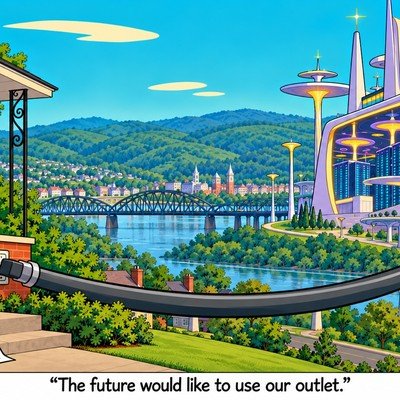
Beaver County faces a dilemma with new data centers, balancing economic potential against local concerns about infrastructure and environmental impact.