
The Chair Problem
Aging brings unexpected challenges, as our bodies require more planning for simple tasks. Embrace strength training and nutrition to reclaim vitality.



Rodger Morrow
Editor & Publisher, Beaver County Almanac
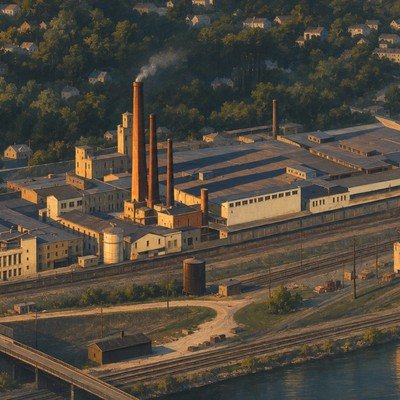
On a football Saturday at Geneva College, there used to be two things to watch at the south end of Reeves Field. One was the game. The other was a brick smokestack. The Armstrong Cork Company plant below College Hill had closed by then, but an older spectator might point out the stack and tell a student what used to come out of it. Beaver County Radio once collected a story about men who worked nearby and brought a spare white shirt to the office. On a warm day, with the windows open, the first shirt might last until lunch.
The business began with a man who could make his deliveries with a wheelbarrow. In 1860 Thomas Morton Armstrong, a 24-year-old shipping clerk and the son of Scots-Irish immigrants, put about $300 into a Pittsburgh cork-cutting shop with John Glass. They cut stoppers by hand, then bought machinery that made the corks more uniform. They supplied the Union Army and were praised for the quality of their goods and for keeping the terms of their contracts. In the war that made “shoddy” a household word, that was enough to get a firm noticed.
When Glass died in 1864, Armstrong’s brother Robert bought his share. That year Thomas began putting the Armstrong name on the corks and sending along a written guarantee. “Let the Buyer Have Faith,” the company said, in a century that generally advised the buyer to beware. A fellow had to be reasonably sure of his cork to sign it.
You can cut many little cylinders out of cork bark and still have more bark left over than you put in the bottle. Armstrong reckoned that scrap could account for 65 percent. The company ground up the leftovers, pressed and baked them into slabs, and sold the result as insulation. There was money in keeping a brewery cold, and the brewery could buy its stoppers from the same people.
By 1903 Armstrong was making corkboard on five acres along 27th Street in Beaver Falls. In 1916 Louis L. Bentley of Beaver Falls patented a board designed to hold together, stay light, and keep out the heat. He assigned the patent to Armstrong. It includes an apparatus for measuring how readily heat passes through a sample. The man who bought the board could have faith. Bentley had instruments.
The finest scraps went into linoleum. Armstrong opened a plant in Lancaster around 1908, the year Thomas died and his son Charles took over. A 1927 patent described how to make a sheet of linoleum look like individually laid tiles. You could have the grooves where the grout belonged without inviting a man with a bucket of grout into the kitchen.
Armstrong moved its headquarters to Lancaster in 1929 and took over the old Beaver Falls Art Tile Company building on 13th Street in 1936. At their peak the two Beaver Falls plants employed about 700 people. During World War II Armstrong made munitions components and airplane parts.
Afterward, with the country putting up houses as fast as it could, the company sold Americans something to put underfoot and overhead. On television, the company sponsored Armstrong Circle Theatre. An evening’s drama might leave you wondering what you would have done in the hero’s shoes. Armstrong was prepared
to take an interest in what those shoes were standing on. By the 1970s it was advertising Solarian vinyl as a floor that would shine without waxing.
The 27th Street plant closed in 1973. Armstrong kept making ceiling tiles on 13th Street and changed its name to Armstrong World Industries in 1980. Asbestos claims drove it into Chapter 11 in 2000. It emerged in 2006 with a trust to compensate people harmed by exposure. The 13th Street plant, which still employed about 150 people as it wound down, made its last ceiling tiles on March 31, 2011. Five years later Armstrong spun off its flooring business to concentrate on ceilings and walls.
The Pittsburgh cork factory became loft apartments. Armstrong gave the 27th Street property to Geneva College, and it became part of the college’s athletic complex. The smokestack hung on for a while after the plant came down. In those seasons a student could go to a football game and get, from the stranger beside him, an account of how the town smelled when the cork was baking. The student probably came to see who would win. He went home knowing why a man in Beaver Falls once took two shirts to work.
Aging brings unexpected challenges, as our bodies require more planning for simple tasks. Embrace strength training and nutrition to reclaim vitality.

As Switch plans a data-center campus at the old Big Beaver racetrack, questions arise about who pays if the project underdelivers on power needs.