There Goes the Electric Bill
Beaver County faces a dilemma with new data centers, balancing economic potential against local concerns about infrastructure and environmental impact.



Rodger Morrow
Editor & Publisher, Beaver County Almanac
“Godzilla Minus Zero” Is Everything Hollywood Has Been Missing By Rodger Morrow, Editor & Publisher Beaver County Almanac
Hollywood has become exceptionally good at destroying cities. Give it enough money, and it will knock down three before you have finished arranging your popcorn. The buildings collapse beautifully. The automobiles turn over with professional assurance. Somewhere beneath the rubble are several million people, although the picture has seldom introduced anyone you would particularly miss.
This is efficient filmmaking. Establishing that somebody matters takes time that could be spent dropping a bus on him.
The Japanese have been trying another method.
In Godzilla Minus One, the 2023 film that made Hollywood’s expensive machinery look faintly ridiculous, director Takashi Yamazaki committed an elementary act of storytelling. He gave us people worth worrying about. Then he introduced a creature large enough to make worrying a reasonable occupation.
His sequel, Godzilla Minus Zero, opens November 6. I have not seen it, which places certain restrictions on my ability to pronounce it a masterpiece. These restrictions are not universally observed in the opinion business. But the returning filmmaker, continuing family story, and early reception offer grounds for expecting something Hollywood has made strangely scarce: spectacle with somebody inside it.
The first film followed Kōichi Shikishima, a kamikaze pilot who had survived the war and consequently believed he had disgraced himself. His government had prepared him to die for his country. It had provided considerably less instruction about what to do if he came home.
He found a devastated neighborhood, a young woman, and an orphaned child. Gradually, among the ruins, they assembled a household. There were meals to obtain, work to find, and the awkward business of accepting affection when you suspected you did not deserve any.
Then an enormous radioactive animal came ashore.
You could understand why this upset them. They had only just begun getting things straightened out.
That was the film’s achievement. The monster threatened a life we had watched people laboriously put together. A demolished house represented more than an opportunity for the visual-effects department. Somebody had hoped to sleep there.
Hollywood often supplies its characters with a different kind of history. They have appeared in six previous pictures, two streaming series, and something you were supposed to watch after the credits. Understanding their unhappiness requires a subscription and a nephew.
Yamazaki’s people needed a roof.
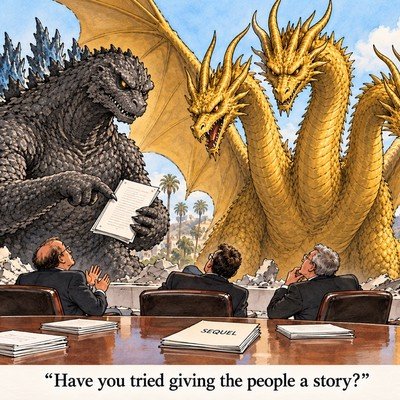
The sequel returns to the Shikishima family in 1949, two years after the earlier disaster. Japan is rebuilding, daily life is returning, and another monster arrives to express dissatisfaction with the arrangements. This one is Ghidorah, a dragon with three heads, which should at least allow him to hold a meeting without hiring consultants.
Godzilla returns, too. Apparently, blowing him apart was insufficient. Anyone who has attempted to cancel an automatic renewal will recognize the problem.
The danger, naturally, is that a bigger sequel will mistake additional destruction for additional meaning. Some early reviewers have reservations about its length and crowded human proceedings. Others praise its spectacle and emotional weight. A reasonable person can await the picture without requiring every critic to salute.
What interests me is the continued attention to ordinary survival.
The first film understood something profound about courage. Men trained to regard their lives as expendable began insisting that they wanted to keep them. They had families, friendships, and unfinished business. Bravery involved trying to return home.
This is a substantial thought to find in a picture about a lizard. I have attended respectable dramas that offered less.
It also explains why the destruction carries weight. Once you care whether a man gets home for supper, you do not need six endangered universes. One blocked road may be sufficient.
People around here understand the importance of making a life in the aftermath of large events. Beaver County’s industrial losses bear no equivalence to Japan’s wartime devastation. But rebuilding, wherever it occurs, eventually comes down to particular people doing particular things: finding work, repairing something, helping a neighbor, and deciding tomorrow deserves another try.
That is where a story lives.
Godzilla Minus Zero will be at Cinemark in Center Township beginning November 6. There is something encouraging about the possibility that a Japanese monster might remind an American entertainment industry how to entertain Americans.
Hollywood will undoubtedly study the results. Executives will commission research, circulate findings, and convene serious discussions about what audiences responded to.
Someone may mention the family, the courage, or the patient business of making us care.
There will be a thoughtful silence.
Then somebody will say, “What if ours had four heads?”
Beaver County faces a dilemma with new data centers, balancing economic potential against local concerns about infrastructure and environmental impact.

Dining out should be about connection, not chaos. As noise levels rise, so does the challenge of enjoying meaningful conversations over dinner.