
Don’t Let Halloween Spook You
Halloween’s roots intertwine with Christian traditions, reminding us to embrace community and joy without fear of its history. Celebrate wisely this October 31.



Rodger Morrow
Editor & Publisher, Beaver County Business
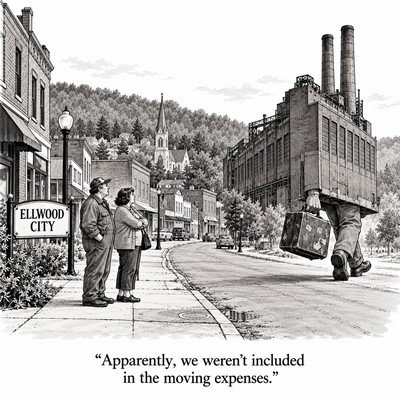
The difficulty with building a town around a factory is that the factory may eventually decide it would rather be somewhere else. The town, having installed sewers, built churches, and buried several generations of its inhabitants, finds relocation more complicated.
Ellwood City knows something about this arrangement. It was developed to accommodate industry, prospered by accommodating it, and eventually learned that industry's attachment to a community did not necessarily extend beyond the next review of operating expenses.
Alfred D. Chandler Jr., the business historian, summarized the logic of corporate organization in a phrase from Strategy and Structure: "structure follows strategy." Decide what you intend to accomplish, then organize the business accordingly. Ellwood City offers a related question: What happens when the business reorganizes and the community remains where the business originally wanted it?
Chandler, who spent much of his career at Harvard Business School, built that argument by studying how DuPont, General Motors, Standard Oil of New Jersey, and Sears, Roebuck reorganized themselves as they grew. He later extended it in The Visible Hand, which won the Pulitzer Prize for History, arguing that the salaried managers of large enterprises had taken over much of the coordinating work Adam Smith had assigned to the market. The invisible hand, in other words, had acquired an organization chart.
Ellwood City's beginnings were unusually deliberate. Henry W. Hartman, an industrialist with wire-manufacturing interests in Beaver Falls, saw an opportunity to turn farmland along the Connoquenessing Creek into an industrial community. In 1890, his associates acquired roughly 600 acres, laid out streets, offered lots, and announced a manufacturing future. The borough was incorporated in 1892.
Most towns acquire a business district after people settle there. Hartman approached the matter from the other direction: he had a business proposition and needed somewhere for its employees to live.
He named the place for Isaac L. Ellwood of DeKalb, Illinois, a businessman associated with the commercial development of barbed wire. But wire fencing and seamless steel tubing were different businesses, and tubing became Ellwood City's industrial mainstay. Ellwood gave the town its name. Seamless tubing gave it its livelihood.
There is a geographical complication, too. Parts of present-day Ellwood City were once in Beaver County before Lawrence County was created in 1849, and the borough still straddles the county line. Beaver County therefore has both a historical claim and a current address, an agreeable arrangement for anyone reluctant to surrender an interesting neighbor.
Hartman's undertaking nearly foundered during the depression of the 1890s. Then Ralph C. Stiefel brought his engineering knowledge to Ellwood, helping establish the seamless-tube industry. In June 1895, the community produced the first American seamless steel tubes made through his pioneering piercing process.
Steel tubing meant customers, orders, and workers. Workers required houses, groceries, schools, churches, and the ordinary commerce of a town. Immigrants arriving from Italy, Germany, and elsewhere supplied much of the labor and helped turn an industrial scheme into a community.
Hartman's plan had been a wager placed in advance: lay out the streets, announce the factories, and the people will come. They came, but not as the abstractions on a developer's prospectus. They brought parishes, social clubs, family recipes, and opinions about how things ought to be run. A town designed for production became a place people regarded as home, which is a different kind of commitment and a much harder one to relocate.
The enterprises soon entered larger combinations. By 1901, major local tube operations had come within U.S. Steel's corporate system. A town launched through individual initiative increasingly depended on decisions made inside a vast organization. Chandler described the advantages of such systems: large companies could assemble capital, develop markets, and coordinate production on a scale beyond the reach of small concerns.
Chandler's research also explains what such an organization does with a place like Ellwood City. In the large, multi-unit enterprise he described, a central office stands above the operating units, judging each by its performance and directing capital toward whatever promises the better return. That is a sensible way to run a sprawling business. It also means that every plant, however much it matters locally, is continually being compared with plants somewhere else. Ellwood's tube works did not answer to Ellwood. It answered to executives who could see the whole map, including all the parts of it where Ellwood City was not.
For decades, the arrangement supported a formidable industrial community. During World War II, the tube mill reportedly employed about 4,200 people. Such a payroll supported considerably more than 4,200 individuals. It circulated through kitchens, shops, mortgage payments, and the small daily transactions by which a town keeps itself going.
The trouble developed when the corporation's requirements and the community's requirements began moving in different directions.
Faced with changing markets, foreign competition, and pressure to consolidate, steel companies reconsidered where production belonged. For corporate management, a plant was one facility among several. For the people around its gates, it was the reason the house had been purchased.
In June 1974, U.S. Steel announced that its Ellwood Works would close, with operations consolidated in Gary, Indiana. The shutdown was completed in January 1975, leaving roughly 1,000 remaining employees without their jobs there. Some qualified for retirement; some received opportunities elsewhere. None of those arrangements could transfer an entire community along with the machinery.
There is a certain symmetry in the destination. Gary was itself founded by U.S. Steel, in 1906, and named for the corporation's chairman, Elbert H. Gary. One company town was being consolidated into another. The difference was that Gary, for the time being, was on the receiving end of the strategy.
Structure followed strategy. The town received the forwarding address.
The economist Albert O. Hirschman supplied a useful vocabulary for this in Exit, Voice, and Loyalty, published in 1970, a few years before the Ellwood announcement. Members of an organization who are dissatisfied, he argued, can leave or they can speak up. Capital is well
suited to leaving. It can be written down, transferred, and redeployed. A town is built almost entirely out of loyalty. Its residents can appeal to the company, petition legislators, and write letters to the editor, but speaking up works best when the listener has some reason to stay. Once a corporation has concluded that its future lies elsewhere, the town's voice becomes largely a matter of record.
Hence the title of this column. Nobody was obliged to ask the town. The decision belonged to people weighing cost sheets, markets, and other mills, and the borough's preferences were not a line item.
That is not proof that every decision was foolish or malicious. A company cannot ignore production costs indefinitely. But a decision can satisfy a company's accounting requirements while leaving substantial costs on other people's books. Those books include the borough budget and the kitchen-table checkbook.
Those costs tend to arrive quietly. A borough that loses its largest taxpayer still has streets to plow and pipes to maintain. A school district still has buildings to heat, with fewer families able to carry the levy. Young people leave to find the kind of steady work their parents found at the mill gate, and the population ages in place. None of this appears in a consolidation announcement, because none of it belongs to the company making the announcement.
My family had a modest connection to this economy. During the 1970s and 1980s, my father's dealership, Morrow Motors, maintained a satellite operation in Ellwood City. We belonged to the layer of commerce that grew around industrial employment. Whatever the prevailing theory of corporate organization, a customer generally found regular wages helpful when contemplating a car payment.
A dealership did not need a graduate seminar to understand that relationship. Neither did a grocer, a barber, or a man selling furnaces. When a payroll disappears, the effect reaches Main Street in stages: purchases get postponed, the old car gets one more repair, and the customer who used to stop in to look finds less reason to stop in at all.
Ellwood City was not alone, and it was not last. Within a decade, closures along the Ohio River, including the Jones & Laughlin works at Aliquippa, would teach the rest of Beaver County the same lesson on a far larger scale. Ellwood simply received the news early.
The tube mill's closure was a severe blow, but describing Ellwood City simply as a collapsed industrial town leaves out a particularly inconvenient fact.
Ellwood City Forge survived.
In 1910, after the Frankford Steel operation closed, brothers David and Jonathan Evans established Ellwood City Forge in the former plant with $25,000 in capital. They had worked there as managers. An industrial closing became the starting point for another industrial enterprise.
It is worth pausing on who made that decision. The people who restarted the operation were not distant owners reviewing a portfolio. They were managers who knew the equipment, the work, and presumably the workforce, and who concluded that the business was worth continuing in the place where it already stood. Chandler celebrated professional management as the engine of the modern corporation. Ellwood City offers a smaller-scale version of the same idea, with the managers living within walking distance of the consequences.
The forge endured the regional steel industry's collapse and remains in business today. Its Ellwood City operation continues at the original site, making specialized forgings with modern equipment and extensive heat-treatment and machining capabilities for demanding industrial markets.
Its advantage was never size. A specialty forge was not going to out-produce a giant integrated mill, and it did not need to. Its strength lies in work that resists standardization: parts made to exacting specifications for customers who care more about whether a component will fail than whether it was the cheapest one available. That kind of work depends on accumulated skill, and accumulated skill does not consolidate easily into a spreadsheet.
Its survival suggests that western Pennsylvania did not simply forget how to manufacture things. Specialized knowledge, investment, flexibility, and customers with exacting requirements still have value. The forge's history does not prove one universal formula for success, but it does establish that the obituary for local manufacturing was filed prematurely.
Nor did the former tube-mill property become permanently useless. Portions were developed as an industrial park, and metals-reclamation operations followed. Reusing an industrial site cannot restore every lost job, but it can give the property another productive chapter.
That distinction matters. The usual story of the Rust Belt is told in totals: jobs lost, population declined, mills demolished. The totals are real, and they are grim. But a town is not a total. It is a collection of particular enterprises, each with its own reasons for staying or leaving, and the particular ones that stayed deserve as much attention as the general trend that left. Ellwood City's story is incomplete without the closing. It is equally incomplete without the businesses that kept their lights on afterward.
Chandler helps explain the organizations that built Ellwood City and the decisions that wounded it. His framework becomes especially revealing when we remember that the corporation and the community are different institutions, with different obligations and different abilities to move.
There is a practical lesson here for anyone in the economic-development business, including those now courting data centers, energy projects, and the next large employer to arrive with a rendering and a ribbon-cutting date. Large employers are worth having. But a community ought to know which of its businesses can leave easily and which are rooted, and it ought to treat the rooted ones as something more than a sentimental footnote. The firms that stay through a bad decade are the ones a town is actually built on.
A company can reorganize its divisions. A town has to continue educating the children.
Ellwood City's history includes both industrial abandonment and industrial persistence, both distant decisions and people who kept finding useful work to do where they were.
The town was not going anywhere.
Some of its businesses, fortunately, felt the same way.
Halloween’s roots intertwine with Christian traditions, reminding us to embrace community and joy without fear of its history. Celebrate wisely this October 31.
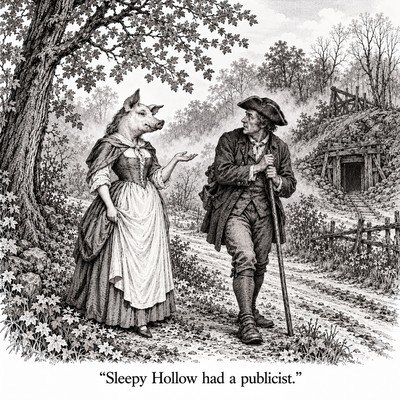
In Cannelton, the legend of the Pig Lady endures, blending history and folklore, reminding us that every ghost story has a human heart.