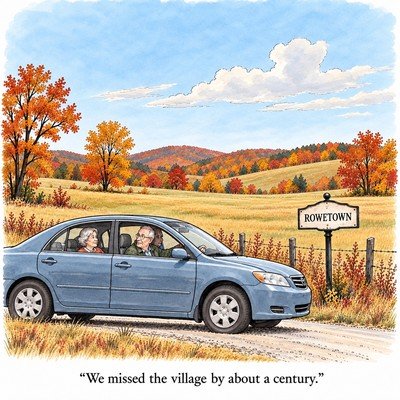
The Village You Just Drove Through
Rowetown’s history is a tapestry of community life, where ordinary intersections held significance, now faded yet vital to understanding our past.



Rodger Morrow
Editor & Publisher, Beaver County Business
The whole generation is womanised; the masculine tone is passing out of the world; it’s a feminine, a nervous, hysterical, chattering, canting age, an age of hollow phrases and false delicacy and exaggerated solicitudes and coddled sensibilities, which, if we don’t soon look out, will usher in the reign of mediocrity, of the feeblest and flattest and the most pretentious that has ever been. The masculine character, the ability to dare and endure, to know and yet not fear reality, to look the world in the face and take it for what it is—a very queer and partly very base mixture—that is what I want to preserve, or rather, as I may say, to recover; and I must tell you that I don’t in the least care what becomes of you ladies while I make the attempt!”
—Basil Ransom, in Henry James’s The Bostonians (1886)
Read today, this sounds as if Basil Ransom had gotten hold of the minutes of a university committee. He lacked our vocabulary. He had no trigger warnings, no inclusion statements, no human resources department to put his complaint into words for him. He had to make do with “coddled sensibilities,” which does nicely. Sometimes progress is just finding a longer word for something your great-grandfather already disliked.
But Ransom is a character, and James is a novelist. Remember this when somebody waves a quotation that seems to settle an argument. James gives Ransom strong opinions, then gives the reader reasons not to trust him. Nothing obliges a novelist to make his most quotable character his most trustworthy.
The story is a tug-of-war over Verena Tarrant, a gifted young speaker. Olive Chancellor wants her for the cause of women’s emancipation. Ransom wants her for himself. Both have big plans for her future. Neither shows much interest in hers. At the end, Ransom carries her off from a hall full of people waiting to hear her, and James leaves her in tears, with a warning that marriage will supply more. Masculine authority is restored, and nobody throws rice.
That matters because the argument is back, in a form James could hardly have imagined: a woman arguing that women’s growing influence may be damaging the institutions they now run. Helen Andrews calls it “the great feminization.” The turning point, she says, came when women stopped being exceptions in important professions and became majorities, or close to it. She ties this to institutional preferences for emotional safety, cohesion, and consensus, and to the habits that travel under the name “wokeness.” Her quarrel is with the governing culture of institutions, not with the competence of every woman in them.
It is a striking idea. It also has the great convenience of explaining several annoyances at once. Any theory that accounts for a canceled lecture, a dreary staff meeting, and an unreadable office memo will find customers.
The demographic change is real. Women became a majority of students at accredited American law schools in 2016, according to the American Bar Association. The Association of American Medical Colleges reported the same milestone for medical students in 2019. These are big changes in two professions we trust with our liberty and our lives. They deserve more thought than the usual announcement that another barrier has fallen.
The economist Tyler Cowen put feminization on his list of seven great revolutions he had lived through, alongside the collapse of communism and the internet. He called it important without calling it a catastrophe. Ranking something with the internet tells you its size. It doesn’t tell you whether to pull the plug.
The hard question is what follows from the numbers. A law school that goes from 49 percent female to 51 percent has crossed an arithmetic line. Whether it has crossed a psychological one takes more proof. Institutions have histories, incentives, leaders, and professional duties. A medical student walking into a lecture hall does not necessarily carry a whole new civilization in her book bag.
Still, it would be odd to insist that changing who belongs to an institution can’t change how it behaves. We praise new perspectives when we want more representation. We can hardly turn around and say perspectives have no consequences when we dislike the result.
Andrews is strongest when she insists that institutions need standards sturdy enough to survive an unpleasant outcome. A university must allow arguments that upset its students. A newspaper must print facts that annoy its readers. A court must sometimes rule for a man nobody would have to dinner. Her worry is that these duties weaken when keeping the peace becomes the first commandment.
I share the worry. A newspaper devoted to protecting everyone’s feelings will soon have trouble reporting the weather. Rain disappoints brides. Sun worries farmers. Snow raises questions of unequal access to shovels. Before long the forecast will need a statement acknowledging the lived experience of people who had planned a picnic.
The trouble starts when kindness is given jurisdiction over truth. Kindness tells the doctor how to talk to the patient. It cannot tell the lab what the test shows. Compassion can shape how a school helps a struggling child. It cannot make a wrong answer right without robbing the child of the chance to learn. Yet it is tempting to treat the discomfort a finding causes as evidence against it. The temptation grows when disagreeing costs you socially and agreeing pays professionally.
Where I balk is at hanging the whole business on women. Men have a long record of punishing dissent, manufacturing unanimity, and mistaking loyalty for truth. They ran inquisitions, party purges, blacklists, and newspaper crusades long before women outnumbered them in law school. A room full of men can grow exquisitely sensitive when somebody questions their authority, or their expense accounts.
Male vanity has never needed help from human resources.
Beaver County supplies a useful reminder of the older masculine world. In 1889, Rudyard Kipling visited Matthew Quay in Beaver, and their conversation turned to books and the senator’s remarkable library. Local accounts also record Kipling’s enthusiasm for the cigars he found here. I picture their meeting through a haze of cigar smoke, two formidable men discussing literature without a facilitator asking whether everyone felt heard. It is an appealing scene. But Quay’s political machine is a useful warning against confusing masculine authority
with impartial government. A room can contain excellent books and still leave important decisions to the man who controls the appointments.
The old boys’ network had rules, but some you learned only after discovering whose nephew you were up against. A profession that shut out able women was already shortchanging merit. Let’s not remember the old arrangement as an exam where everybody started with the same pencil.
Our own history makes the point. Gertrude Rapp directed silk production at Old Economy and won recognition for the quality of its goods. Grace Greenwood, whose home was in New Brighton, made her name as an author, journalist, and abolitionist. Neither fits comfortably into a theory that assigns enterprise to men and nervous solicitude to women. Silkworms cannot be persuaded to improve production by an inclusion statement, and a woman entering nineteenth- century journalism needed considerably more than a desire to keep the peace.
Later, Gert Trobe became a familiar voice on WBVP, helping establish a place for women in local broadcasting. These women worked in different fields, under different circumstances. What connects them is achievement. Beaver County would have been poorer without their contributions, whatever the prevailing theory about women’s proper sphere.
Admitting women enlarged the pool of talent. The job now is to judge that talent hard, and to resist every attempt to substitute representation, connections, or emotional appeal for proven ability.
Here James is a better guide than Ransom. Among the novel’s women is Dr. Prance: practical, absorbed in her work, unimpressed by the commotion around her. While everyone else sees events through causes and attachments, she minds what is physically in front of her. She spoils any tidy division between manly realism and womanly sentiment, and James planted her in the very novel that holds Ransom’s famous lament. She would be an asset on any modern committee.
Sensitivity and cowardice are different things. You can notice someone’s distress and still refuse an unreasonable demand. A manager can listen politely and still decide. A professor can care about students and still make them read something they dislike. The failure comes when people in charge give up those duties because giving up is easier than explaining themselves.
That failure thrives wherever administrators fear complaints, employers fear publicity, and ambitious people learn that expressing concern costs less than exercising judgment. Those incentives deserve as much scrutiny as the sex of the people responding to them. Otherwise, “feminization” becomes one more word that seems to explain everything and ends up explaining very little.
Here in Beaver County, the stakes are familiar. We want the bridge inspected honestly, the public budget accounted for, a school that teaches, and a newspaper willing to ask an awkward question. A property assessment needs a defensible calculation, not a reassuring tone of voice. None of that gets easier because the institution in charge has achieved perfect internal harmony.
Sometimes the awkward person is the one doing the useful work.
Ransom wanted to look reality in the face without flinching. A worthy goal, though he had less of the knack than he thought. Reality includes the talents of women, the failings of men, and the inconvenient possibility that civilization needs virtues neither sex owns outright.
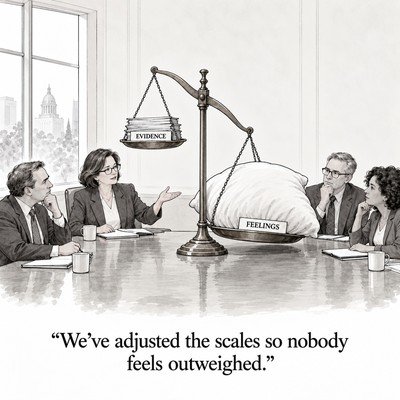
The scales have tipped in important professions. What we put on them now matters more than cheering the change or mourning it in advance. Evidence, competence, courage, fairness, and compassion all deserve weight. Hurt feelings cannot be allowed to outweigh the rest.
Henry James knew how easily a grand principle becomes a way of getting what you want. Helen Andrews asks whether institutions are losing the nerve to resist. The question deserves a hearing.
Preferably before somebody decides the hearing makes people uncomfortable.
Rowetown’s history is a tapestry of community life, where ordinary intersections held significance, now faded yet vital to understanding our past.

This October, embrace the journey. Discover the hidden stories in the landscape as you make your way to the pumpkin patch. There’s more than meets the eye.