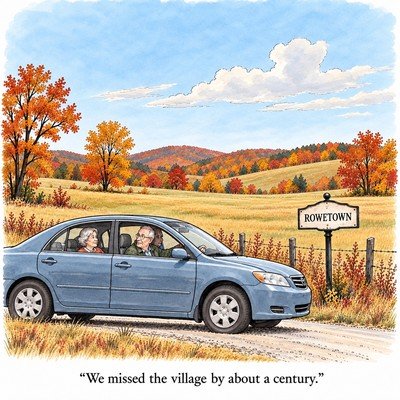
The Village You Just Drove Through
Rowetown’s history is a tapestry of community life, where ordinary intersections held significance, now faded yet vital to understanding our past.



Rodger Morrow
Editor & Publisher, Beaver County Business
Every October, otherwise sensible people climb into their cars and drive halfway across the county to buy things that would have grown perfectly well in the backyard. I am one of these people. We come home with a pumpkin, three pots of chrysanthemums that will not see Thanksgiving, and a telephone full of photographs of trees getting ready to go bald. It is a pleasant custom, and I would not abolish it. I would only add one item to the shopping list: a little understanding of the ground we drove over to get there.
A landscape is a book that has been through too many editors. I say this as an editor. Rivers have cut whole chapters. Railroads have written over paragraphs. Developers have inserted long passages about luxury living. Still, enough of the original survives to make good reading, even at forty miles an hour.
Start with the shape of things. Along the Ohio and the Beaver, roads and railroads crowd onto narrow strips beneath the hills like passengers on a bench built for two. Nobody arranged this for the convenience of your morning commute. Water cut the valleys, and people squeezed their traffic into whatever room was left. Geography got there first and has been supervising construction ever since, without once applying for a permit.
A road cut offers another page. Those bands of rock were laid down long before anybody needed a mum for the front porch. Their different textures suggest conditions changed while the work was going on. The hillside was not poured in one batch, like a driveway. You need not identify the layers. I can’t, and the hillside has never held it against me. Merely knowing it has a history improves it considerably.
Then look for the human handwriting.
A suspiciously level strip running along a slope may suggest an old transportation route. Stonework beside a creek raises questions about a bridge, a mill, or a retaining wall. A doorway in a brick building that no longer goes anywhere tells you the building once had a different arrangement with the street. None of these proves a story by itself. Each gives you a question worth asking, which is more than can be said for most billboards.
Bridgewater makes more sense once you picture canal boats loading and unloading along its waterfront. The Beaver River was once part of a transportation system linking the Ohio with communities farther north. What looks today like an agreeable spot for lunch was also a place where freight changed hands and fortunes acquired a mailing address.
Upstream, Fallston’s early industry depended on the river’s waterpower. Sitting below the falls was a business advantage in the days before electricity let a man put a factory wherever he pleased. A place name can be remarkably informative, once we stop treating it as something for the navigation system to mispronounce.
Archaeology does not require a pith helmet or a quarrel over who gets the golden idol. At Fort McIntosh in Beaver, surviving stone foundations make a vanished fort legible. Excavations
turned up wall foundations, fireplaces, and thousands of artifacts. Stop, walk around, and imagine rooms where the sky now shows through. The missing building becomes part of what you see.
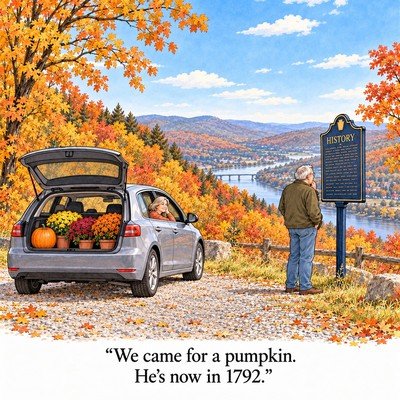
Historical markers are permitted. This is an outing, not an examination, and nobody is grading. Near Baden, the Logstown marker recalls a substantial Native town and the diplomacy surrounding the struggle for the Ohio country. Suddenly the roadside has inhabitants, ambitions, and quarrels a good deal older than the traffic going past.
Pull over properly, of course. The passenger enjoys a great advantage in landscape reading. The driver should keep his scholarly interest confined chiefly to the landscape directly ahead, particularly the part occupied by another reader who has stopped without warning to admire a maple.
So take a few detours on the way to the pumpkins. Notice where a farm sits, where a road bends, what an old foundation might explain. Ask a question. Read a sign. Look up the answer later.
The leaves will supply the color. The ground beneath them will supply the story.
And the pumpkin will still be there when you’re done. Of all autumn’s attractions, the pumpkin is the one least likely to insist on keeping a schedule.
Rowetown’s history is a tapestry of community life, where ordinary intersections held significance, now faded yet vital to understanding our past.
The debate over women’s growing influence in institutions raises critical questions about standards and truth versus emotional safety in our society.