
The Miller’s Tale
Before Beaver County thrived on steel and glass, its heart lay in the mills that turned grain into flour, connecting farmers and communities through simple…



Rodger Morrow
Editor & Publisher, Beaver County Business
John Milton wrote, “They also serve who only stand and wait.”
He was brooding about his blindness and his duty to God, not about a party of six that wants separate checks. Still, restaurant workers have a fair claim on the line. They stand. They wait. Then they come back to find that the gentleman who needed twelve more minutes with the menu now wants to know what has become of his dinner.
Most of us know restaurants only from the sitting-down position. It is a comfortable place for developing theories about how restaurants ought to be run. The soup should be hotter, the service quicker, the prices lower. We are especially firm about the prices. We remember what a hamburger cost in 1978 and see no reason the cow should have changed its arrangements.
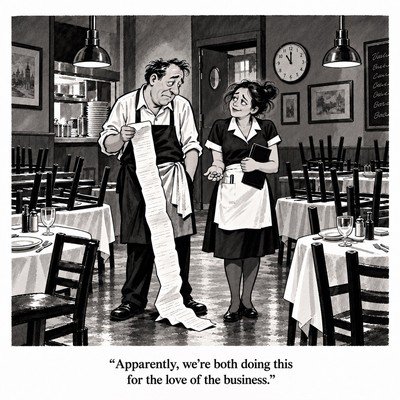
From the other side of the table, the view is different.
A restaurant owner runs a factory whose inventory spoils, a store whose customers arrive hungry, and an employment agency whose evening shift has just developed car trouble. All three businesses share one building. If the refrigerator quits, they can go down together.
The money passing through the cash register is misleading. A restaurant that takes in a million dollars a year sounds like a million-dollar business. It is, in the sense that it carries a million dollars’ worth of worry. The National Restaurant Association’s 2025 operations report found that the median full-service restaurant it surveyed kept 2.8 percent of sales as pretax income in 2024. On a million dollars, that is $28,000 before income taxes. Owners pay themselves and keep their books in various ways, but nobody should mistake sales for riches.
There are easier ways to get rich. Most of them involve owning something that does not require fresh parsley.
Food and labor eat much of the money before the landlord even introduces himself. Then come electricity, gas, insurance, repairs, card fees, equipment payments, and all the other bills that show up right on time even when customers don’t. An empty table is cheap to serve. It does nothing for the rent.
Inventory misbehaves. A hardware man can keep an unsold wrench on the shelf until somebody wants it. Nobody can do that with flounder. Food shrinks in the pan, gets lost in the trimming, or spoils while waiting for somebody to order the special. Every generous portion has an arithmetic consequence. So does every steak sent back by a diner who has just learned that medium rare involves pink.
Raising prices looks like the obvious cure until you try it. Customers have grocery bills, utility bills, and memories. They can stay home. In Beaver County, repeat business is
everything: the family that comes every Friday, the lunch regulars, the people who order the same pizza every time and would regard a new crust as a breach of contract. Loyalty helps. It does not stretch a customer’s paycheck.
Nor does affection keep an owner going forever. DeAngelis Donuts in Rochester closed in June 2024 after its longtime owner, Dick DeAngelis, died. D&G Pizza in Beaver Falls announced it would close in December 2024 after some sixty years; the owner spoke of his father’s death and the years they had worked side by side. These were family businesses run by people with human limits, not lines on a spreadsheet.
“Somebody should keep it going,” people say. The somebody saying it is seldom volunteering.
Still, sympathy for owners should not blind us to the people carrying the plates. What the owner’s ledger calls labor, the worker’s household calls rent. The owner worries about meeting payroll. The worker worries about what payroll will meet.
In Pennsylvania, an employer taking the legal tip credit may pay an eligible tipped employee as little as $2.83 an hour in cash wages. Wages and tips together must come to at least $7.25 an hour, and the employer has to make up any shortfall. These are legal floors, not reports of what servers actually make. They are also a thin foundation for a household.
Some servers do well in busy places. Others draw the Tuesday shift, when the main customer is a man nursing a coffee while he waits for his inspection sticker. Tips rise and fall with the traffic, the station assignments, the season, and the whims of strangers. The car payment, meanwhile, prefers a fixed amount.
Serving takes memory, balance, diplomacy, and the ability to look delighted while being interrupted. A good server keeps track of the allergies, the refills, the missing order, and the table that has to leave in twenty minutes but hasn’t ordered yet. The customer sees the smile. Behind it may be aching feet, a babysitter watching the clock, and a running calculation of whether tonight will cover tomorrow.
Kitchen workers have a different deal. Cooks, dishwashers, and prep workers may see little or none of the tips. They work through the dinner rush amid heat, noise, wet floors, and sharp edges. A dishwasher can be essential to the whole operation and invisible to everyone enjoying it.
Restaurant hours also run against family life. People go out on evenings, weekends, and holidays, which is exactly when restaurant workers have to go in. Child care and rides must be fitted around those hours. A missed shift hurts the budget. A late closing can wreck the arrangements that made the shift possible.
The new federal “no tax on tips” law gives real relief to those who qualify, but the slogan promises more than the fine print delivers. For tax years 2025 through 2028, eligible workers may deduct up to $25,000 in qualified tips, subject to income limits and other rules. That lowers federal taxable income. It is not a $25,000 check. Social Security and Medicare taxes still come out.
Nor can it produce the tip that was never left, or give the dishwasher a share of the server’s. A tax break helps with money already earned. It does not fill an empty dining room.
So owner and worker are stuck with a hard bargain. Better pay costs money. Poor pay costs people. Turnover means hiring, training, mistakes, and worn-out employees covering the gaps. Cutting staff may improve the arithmetic while ruining the service that brings customers back.
No slogan settles this. A restaurant needs enough money coming in to pay people decently, keep its standards, and give the owner a reason to unlock the door tomorrow. Customers need prices they can afford. All of it has to work out at the same table.
Those of us sitting at that table can at least behave better while we’re there. Be patient with a busy crew. Tip fairly. Take a real complaint to someone who can fix it. Remember that lingering long after closing keeps somebody else from going home.
Milton’s line honored a kind of service that might otherwise go unnoticed. The people who keep our coffee coming, our kitchens running, and our gathering places open deserve a little of the same.
We get to sit down.
Before Beaver County thrived on steel and glass, its heart lay in the mills that turned grain into flour, connecting farmers and communities through simple…
Eva Marie Saint, a Hollywood legend who defied stardom, passed away at 102, leaving behind a legacy defined by authenticity and unwavering integrity.