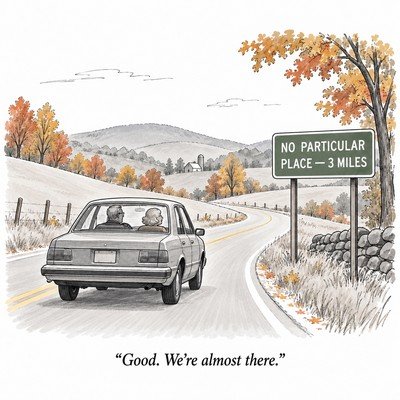
No Particular Place to Go
Embrace early fall in Beaver County with aimless drives, fresh cider, and unexpected discoveries. Adventure awaits just beyond your familiar routes.


Rodger Morrow
Editor & Publisher, Beaver County Business
There are certain problems Beaver County will never have.
Our subway will never be overcrowded, because we have none. No one will complain that the Beaver skyline blocks the afternoon sun. And the commissioners will never be asked what to do with a 725-foot skyscraper that nobody wants and nobody can afford to tear down.
For that, we should be grateful.
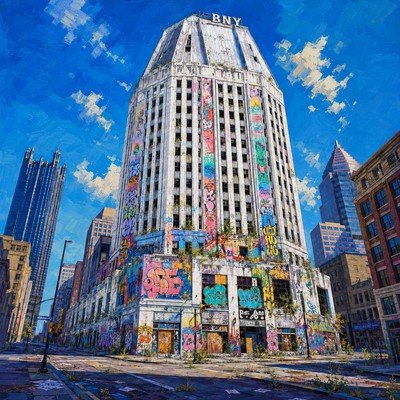
Pittsburgh, meanwhile, has the BNY Mellon Center.
The 54-story tower at 500 Grant Street is the city’s second-tallest building — 1.7 million square feet, rising directly over Steel Plaza station, on some of the best real estate in Western Pennsylvania. It is also, by the estimate of one of Pittsburgh’s most experienced developers, worth approximately nothing.
Possibly less.
Aaron Stauber has spent more than three decades buying buildings other people had given up on. As president of Rugby Realty, he has acquired and redeveloped more than 10 million square feet of property worth more than $1 billion, including Pittsburgh’s Frick Building, Koppers Building, Gulf Tower, and One Oxford Centre — enough of Grant Street that he might reasonably be called its superintendent.
He doesn’t flinch at peeling paint or an empty lobby.
So when KDKA’s Marty Griffin asked what Stauber would pay for the BNY Mellon Center, the answer was worth noting.
“If somebody gave me the building today for free, I wouldn’t take the property,” Stauber said. This defies one of the oldest laws of American commerce, under which anything free is worth taking, especially if it is 725 feet tall and wears a mansard roof.
But Stauber has done the arithmetic.
MetLife owns the building. BNY — heir to the old Mellon Bank — leases nearly all of it, and is not leaving Pittsburgh, which is the good news. It is only moving next door, into a renovated campus at 500 Ross Street, complete with terraces, a fitness center, and the other amenities companies now offer in the hope that employees will remember where the office is.
The bad news is what gets left behind.
BNY’s lease runs through 2028, though the employees are expected out by 2027. Subtenants have already begun to leave. Unless MetLife finds another giant corporation in urgent need of 1.7 million square feet downtown — and none has surfaced — the second-tallest building in Pittsburgh may soon be nearly empty.
Downtown already runs about 21 percent vacant. Add the BNY tower, roughly a tenth of downtown’s Class A office space, and that number could climb another six points.
This isn’t a shuttered storefront with a phone number taped to the glass. This is an entire vertical city, going dark floor by floor.
The obvious answer is apartments. Every obsolete office tower in America eventually attracts someone saying, “Why don’t they just put apartments in there?” It has the tidy logic of turning a cigar box into a birdhouse.
Apartments, unfortunately, need windows.
The BNY Mellon Center was built with enormous floors around an equally enormous core — fine when the middle holds filing cabinets and conference rooms, less fine when it holds a bedroom you’re paying $2,400 a month to occupy 80 feet from daylight.
Conversion would also mean new plumbing, new heating and cooling, new kitchens and bathrooms, and a few hundred million dollars. Stauber, who is converting the far narrower Gulf Tower, says the arithmetic on BNY Mellon Center never comes out right.
The next answer is to keep it as offices — which requires a tenant large enough to fill several Beaver County business districts stacked on top of each other, willing to spend a fortune tearing out BNY’s build-out to install its own. Office tenants tend to want less space these days, not more, and it will be a hard sell to market 500 Grant Street as the future of office life while its main occupant flees next door to escape it.
Failing that, one could simply leave the building empty.
“Simply” is doing a great deal of work in that sentence.
An empty skyscraper still wants heat, power, insurance, security, sprinklers, inspections, taxes, and enough upkeep to keep 1.7 million square feet from becoming a very tall ruin. Stauber puts the annual carrying cost at $10 million to $12 million; other estimates go as high as $16 million. Which is how a building offered for free acquires a negative price — the new owner loses nearly $1 million a month before he’s picked out the coffee machine.
The assessed value has already dropped from nearly $150 million to about $59.6 million, a fall of roughly 60 percent, costing the City of Pittsburgh more than $725,000 a year, with more losses still for the county and the schools. If the tower goes empty, expect another appeal.
By this point, demolition starts to look like common sense. Implode it, end the carrying costs, and put something built for this century on a valuable downtown lot.
There’s one complication.
Pittsburgh put a subway under it.
Steel Plaza station and its tracks run beneath the property, tunneled through to the U.S. Steel Tower complex. Dropping 725 feet of steel and concrete onto a working transit line calls for an engineer of rare talent and no visible nerves.
That leaves deconstruction — cranes, and the building coming apart piece by piece, the construction footage run in reverse. Nobody seems sure what that costs. The safe answer is: a great deal.
So Pittsburgh has arrived at the perfect civic predicament: a building too big to fill, too deep to convert, too costly to leave standing empty, and too firmly rooted over public transit to blow up. There has even been talk of MetLife simply donating the tower to the city — generous in roughly the way it would be generous to donate a Bengal tiger to a kindergarten.
Before accepting, the mayor might ask what the city would do with it, who covers the annual bills, and whether Pittsburgh taxpayers have ever once expressed a longing to own a 54-story bank building with no bank in it.
Stauber’s advice is admirably short: until there’s a plan and a price, leave it alone.
Back home, we have our own empty buildings, our own falling assessments, our own abandoned mills and factories that outlived the purposes they were built for. We are not strangers to economic change. If anything, we’ve had rather more of it than we asked for.
But our white elephants have the decency to stay near the ground.
An abandoned mill may sprawl across 100 acres, but nobody has to dismantle the sky to be rid of it. A vacant storefront in Beaver Falls becomes an apartment without stranding the bedroom half a block from the nearest window. Even our biggest ruins can generally be knocked down without a call to the transit authority first.
The BNY Mellon Center went up in 1984, near the end of the era when a company’s importance was measured partly by how many floors it could stack underneath the chairman’s desk. It was a monument to Mellon Bank, to Renaissance II, and to the belief that downtown office workers would go on multiplying forever.
Forty-two years later, the Mellon name is gone from the roof. Only “BNY” is left, sitting slightly off-center — an honest enough sign for a building whose future has gone a little off-center too. From Beaver County, the tower still looks magnificent.
That’s one advantage of living 30 miles away. From here, you get the skyline and skip the carrying costs.
Which may be the most sensible use anyone has yet found for the BNY Mellon Center.
Embrace early fall in Beaver County with aimless drives, fresh cider, and unexpected discoveries. Adventure awaits just beyond your familiar routes.

Art’s evolution from craftsmanship to the realm of theory raises questions about value and authenticity, blurring the line between creator and critic.