No Particular Place to Go
Embrace early fall in Beaver County with aimless drives, fresh cider, and unexpected discoveries. Adventure awaits just beyond your familiar routes.


Rodger Morrow
Editor & Publisher, Beaver County Business
How craftsmen became Artists, critics became priests, and the invoice became part of the masterpiece.
By Rodger Morrow, Editor & Publisher Beaver County Almanac
There comes a dangerous moment in the life of anyone who makes things: the moment he stops saying "I paint pictures" or "I write stories" and starts saying "I am an artist." Only two words change. Whole neighborhoods have been ruined by less.
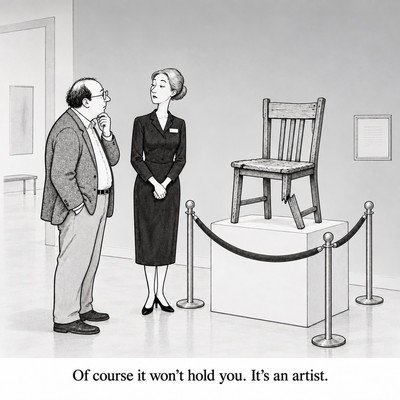
A craftsman worries about the work. An artist worries about what the work reveals about the artist.
The craftsman asks whether the chair will hold a man. The artist asks whether the chair challenges our assumptions about sitting. Soon nobody can sit down, but there's a catalog explaining why.
This may be unfair to Michelangelo, who earned a little vanity painting the Sistine ceiling with paint dripping in his eyes. But did he think of himself as an Artist, capital A? Or as a highly skilled man hired to decorate a ceiling for a very demanding client?
Pope Julius II did not say "explore your truth." He wanted the ceiling done.
Michelangelo complained about the assignment, the conditions, the money—which makes him sound less like a visionary than a very good contractor stuck with a difficult homeowner. The difference is that his homeowner commanded armies and could excommunicate him.
Edward Hopper also started as an illustrator, making pictures for magazines and ads because eating hadn't yet been recognized as a bourgeois distraction.
Illustration demanded discipline: the picture had to say something, fit the space, arrive on time. An editor could say "the woman's hand looks odd" without being accused of suppressing Hopper's inner journey.
Later Hopper became a Great American Painter. Luckily he kept the illustrator's habits— recognizable rooms, streets, and lonely people who look as though they've just learned the diner is out of pie. His paintings suggest mystery without needing a docent to explain that the rectangle represents the collapse of Western civilization.
Andy Warhol did some of his best work before the world promoted him from commercial illustrator to Artist. His early shoe drawings are light, witty, alive—made for clients, which meant they had to please somebody besides Andy Warhol.
Once he became an Artist, the shoe gave way to the soup can. One soup can was clever. Thirty-two were an event. A roomful was a movement. Eventually you suspected Campbell's had been elected to office rather than painted.
Which brings us to Tom Wolfe and The Painted Word, his cheerful 1975 drive-by on the modern art establishment. Wolfe's argument: art had stopped being visual and become an illustration
of theory. The painting wasn't the thing anymore. The explanation was the thing. The canvas just stood nearby, looking important.
Modern art, he said, proceeded by subtraction—first the story, then the recognizable object, then perspective, depth, drawing, design, and finally most of the paint. By the time Conceptual Art arrived, the artwork had nearly vanished, leaving a typed page explaining what would have been there.
Wolfe's villains were the critics—Greenberg, Rosenberg, Steinberg—who supplied the sacred texts. Artists illustrated the critics, museums certified the results, collectors bought them, and the public shuffled through wondering whether the janitor had forgotten to remove a pile of rope.
The same infection spread through literature. The writer becomes an Author. Story, character, clarity—the old obligation to hold a reader's attention—start to seem vulgar. The novel investigates its own impossibility. The poem needs six pages of notes. Object, and you lack the necessary framework—a dignified way of saying the emperor's suit is visible only to subscribers.
Craftsmanship humbles you, because the work can fail. The chair collapses. The portrait doesn't look like the sitter. The sentence lies there like a dead fish. Calling yourself an artist is protection: failure becomes experimentation, confusion becomes complexity, boredom becomes a courageous refusal to entertain.
That protection becomes nearly invincible once the federal government joins the congregation.
The Budget as Halo
Private taste is one thing. A man may ruin his own living room with a sculpture that looks like a radiator in distress—that's liberty. The trouble starts when the same object gets baptized with public money and treated as a civic sacrament.
America didn't invent this habit, but it professionalized it. The National Endowment for the Arts, born in 1965 in the Great Society's afterglow, has drawn annual appropriations large enough to confer official seriousness on whatever it blesses. The Corporation for Public Broadcasting has run the same pipeline for PBS.
Stations will tell you federal money is only a sliver of their budgets. True—and that's the point. A sliver from Washington isn't a majority share. It's a certificate.
PBS didn't invent the painted word. It put the painted word on a tote bag and called it public service. The taxpayer feels improved; the artist feels necessary. Neither has to ask whether the chair still holds.
The Kennedy Center is the marble version: a living memorial kept up with federal money, programming paid by tickets and donors, and a board whose trustees are appointed by the President. A president names trustees. Trustees govern the national stage. The national stage announces, by existing, that the nation has an official taste.
This is sanctification by budget line. The craftsman's test—does the work hold?—is replaced by a civic one: has it been appropriated? Once the line item exists, the argument is over. Cut it,
and you're attacking art itself. Defend it, and you're defending civilization. The theory is the artwork. The performance is the receipt. Wolfe's Cultureburg was a few blocks of Manhattan. The federal version is a zip code with a flag.
1989, or When the Catalog Reached the Senate Floor
The arrangement held up so long as the catalog stayed inside the museum. In 1989 it reached the Congressional Record.
The NEA never wrote a check labeled Piss Christ. In 1987 it gave the Southeastern Center for Contemporary Art in Winston-Salem seventy-five thousand dollars for its Awards in the Visual Arts program. A jury chose ten artists; Andres Serrano got a fifteen-thousand-dollar fellowship. One of his pictures showed a plastic crucifix submerged in a golden liquid he identified as his own urine. The show toured for months. Almost nobody cared until it reached Richmond and the American Family Association mailed the country.
Robert Mapplethorpe's retrospective, The Perfect Moment, was organized on a thirty- thousand-dollar NEA grant. It mixed flowers and formal portraits with homoerotic and sadomasochistic images. Mapplethorpe died of AIDS in March 1989. By June, the pictures were a legislative exhibit.
On May 18, Senator Alfonse D'Amato tore up a catalog page on the Senate floor. Senator Jesse Helms called Serrano "not an artist, he is a jerk"—eight words, a complete aesthetic theory. Representative Dick Armey offered to carry the Mapplethorpe catalog onto the House floor himself.
The Corcoran Gallery canceled its Washington stop rather than endanger the endowment's appropriation. The Washington Project for the Arts picked the show up. The photographs, which had been pictures, were now a test of civic courage.
Congress performed the usual ritual. The House cut forty-five thousand dollars from a budget of roughly $171 million—exactly the sum of the two grants. The Senate attached a Helms amendment barring funds for "obscene or indecent materials" and for work that "denigrates the objects or beliefs" of religious or nonreligious adherents. Conferees narrowed the ban to work the endowment judged obscene under the Miller test, scolded the agency in report language, and left the overall appropriation standing.
That was the NEA's first statutory content restriction. Both sides told a clean story, and both left something out. Helms was right that a subsidy isn't a right. The museums were right that senators make clumsy curators. Neither side wanted to say the Wolfe point out loud: the pictures were no longer asked to hold the eye. They were asked to hold a coalition.
The Decency Clause
A year later, Congress tried to make the coalition permanent without looking like Helms.
The 1990 reauthorization didn't abolish the endowment or adopt Helms's original list of forbidden subjects. It produced something more modern—a sentence that sounds like manners and functions like a theory. Section 954(d)(1) directs the NEA chairperson to judge applications by "artistic excellence and artistic merit," while taking into consideration "general
standards of decency and respect for the diverse beliefs and values of the American public." The same section declares obscenity without artistic merit and unfundable.
This is the painted word enacted into law. Excellence stays the advertised criterion. Decency and respect are to be "taken into consideration"—legislative English for: we won't say what the picture must look like, but we'll say what the explanation must include. The statute never defines decency, or says how much weight it carries. The National Council on the Arts implemented the clause in December 1990 mainly by promising diverse advisory panels— geography, ethnicity, aesthetic range—as if a balanced jury were the same thing as a standard. The government had rediscovered the critic's oldest trick: when you can't describe the good, appoint the right committee.
Four performance artists—Karen Finley, John Fleck, Holly Hughes, and Tim Miller, later the NEA Four—had their grants rejected and sued, arguing the clause was vague and a tool for viewpoint discrimination. Lower courts agreed. In 1998 the Supreme Court, 8–1, didn't. Justice O'Connor wrote that Congress may set spending priorities; funding one project and not another isn't the same as banning speech; and "decency" is no foggier than "artistic excellence," a phrase the endowment had used all along. Justice Scalia, concurring, was blunter: of course the clause discriminates among viewpoints, and Congress may do that with the checkbook. Justice Souter, alone, called it what the artists said it was.
The Court was legally plausible and aesthetically revealing. A republic may decline to buy a picture—that's shopping, not censorship. The trouble is the shopping list. "Decency and respect for diverse beliefs" doesn't describe a canvas. It describes an audience the government wants to soothe. The craftsman still has to make the chair hold. The applicant now has to make the chair hold and reassure a hypothetical public that sitting in it won't offend anyone—a test administered by people who will never sit down.
Notice what the clause does to Wolfe's diagram. In 1975 the sacred text came from Greenberg. In 1989 it came from Helms, on the floor. In 1990 it came from the U.S. Code, written softly enough to survive the First Amendment and vaguely enough to survive any particular picture. The endowment never had to reject work as indecent. It only had to consider decency—the perfect bureaucratic verb. It can't be photographed. It can't fail. It can only be cited.
The artists heard a muzzle. The senators heard a fig leaf. Both were half right. The clause didn't confiscate brushes; it changed the catalog copy. From then on the federal patron wouldn't just pay for art—it would pay for art that could be described, in a grant file, as respectful. That's not the same as making something true. It's the same as making something fundable.
Medals, Laurels, and Other Official Adjectives
Titles are cheaper than buildings and travel farther.
The Presidential Medal of Freedom is the nation's highest civilian honor, given to soldiers, scientists, civil-rights workers, and, increasingly, singers, actors, architects, and novelists. Some earned every inch of ribbon. Others got what looks, from a distance, like an expensive thank-you note. The medal doesn't improve the song. It improves the song's standing in the room where standing is everything.
Wolfe's gurus wrote essays. The White House writes citations. Both tell the audience what it's supposed to have seen. Believing is seeing works even better when the believer is the commander in chief.
The Poet Laureate of the United States is a quieter consecration. The post began as Consultant in Poetry to the Library of Congress, funded by a private gift from Archer M. Huntington. The Librarian of Congress appoints the laureate; Congress upgraded the title in 1985. Consultant became Poet Laureate Consultant in Poetry—a lot of capital letters for a job still paid from a dead philanthropist's endowment.
The title is the product. America, uneasy with kings, still likes a court poet so long as the court is a library. A good poet stays a good poet. A fashionable one becomes the Poet of the United States—a promotional category, not a meter.
Once the state has a favorite kind of seriousness, the craftsman's failures stop looking like failures. They look like underfunded excellence. Significance is a wonderful word. It can't be weighed, timed, or sat upon. It can only be announced.
The Canvas as Invoice
If official blessing is the respectable face of the painted word, the farcical face arrived wearing aviator sunglasses and a very new hobby.
Hunter Biden began painting in earnest while climbing out of addiction—a human story. The trouble isn't that a president's son picked up a brush. It's what the market did next.
In 2021, a Manhattan gallery showed his work with prices reported as high as half a million dollars. The White House let it be known that an ethics arrangement would keep buyers anonymous, even from the artist. The gallery's owner, Georges Bergès, later told congressional investigators no such agreement existed—that Hunter Biden knew the identities of buyers accounting for about seventy percent of the value sold. Total sales came to roughly $1.5 million among a handful of collectors. Hollywood lawyer Kevin Morris bought $875,000 worth. Democratic donor Elizabeth Hirsh Naftali bought about $94,000 worth and was later appointed to the U.S. Commission for the Preservation of America's Heritage Abroad.
The phrase that fits is older than SoHo: money moving through an object whose price can't be checked against any public standard of skill. A chair has a test. A novice abstraction priced like a trophy has a different one: who needs the receipt?
If a painting exists to illustrate a text, the text can be a theory of flatness. It can also be a theory of proximity. The canvas doesn't have to be good—it has to be plausible enough to hang. Once it hangs, the check is no longer for a picture. It's for a relationship that would look unseemly written up as a personal-services contract. Art, used this way, isn't a window. It's a polite envelope.
Follow the sequence. First the story left the picture. Then the object left. Then the paint thinned. Then the explanation took the wall. Then Congress wrote decency into the grant file. Finally the explanation didn't even need to be aesthetic—only official enough, or familial enough, that no one would say the obvious thing: this object is expensive because of who made it, not what it is.
Helms, the museums, and the Supreme Court were already rehearsing the later farce. One side treated the grant as a moral endorsement. Another treated it as a civil right. The Court treated it as a shopping decision with polite adjectives attached. None of them treated the picture as a
picture. By the time a president's son needed a market, the country had spent thirty years practicing how not to look.
What Is Left to Sit On
The world needs artists the way it needs carpenters and cooks—people who know how to finish something. The danger is the promotion that arrives before the work has been asked to do any work.
Federal budgets can't make a painting true. A decency clause can't make a painting decent. Medals can't make a song necessary. A laureateship can't make a stanza scan. A first son's show can't turn a transfer of funds into a school of painting. Each institution teaches a country to confuse consecration with quality—training patrons to buy the catalog, makers to decorate it, and the rest of us to stand in the gallery doubting our own eyes, which is the one skill a republic doesn't need to subsidize.
Michelangelo painted the ceiling.
He left the title to history. History didn't need a line item, a medal, or a consideration of diverse beliefs to notice the difference. The figures still hold. The vault still holds. A man can look up without a theory—the oldest test, and still the only one that doesn't bounce.
The world might be safer if artists thought of themselves as craftsmen until the rest of us decided otherwise—and if the rest of us, Congress included, remembered that "Artist" is not a tax category, a medal, a way of moving money, or a paragraph in an appropriations report. It's a rumor that sometimes, after a long time and a finished job, turns out to have been true.
Until then, someone has to make sure the chair will hold a man. The catalog can wait.
Embrace early fall in Beaver County with aimless drives, fresh cider, and unexpected discoveries. Adventure awaits just beyond your familiar routes.

The tragic case of Lindsay Clancy raises urgent questions about mental health, motherhood, and the complexities of psychiatric treatment in our society.