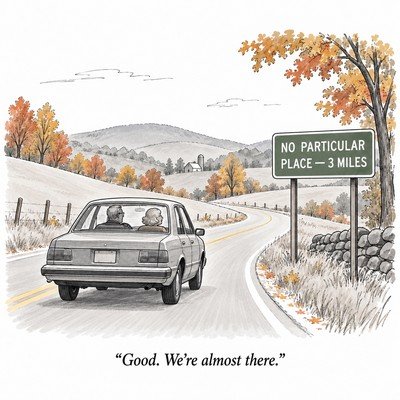
No Particular Place to Go
Embrace early fall in Beaver County with aimless drives, fresh cider, and unexpected discoveries. Adventure awaits just beyond your familiar routes.



Rodger Morrow
Editor & Publisher, Beaver County Business
There is a Marine base in California named after a man from a river town in Pennsylvania. Nobody planned it that way. Nobody ever does.
Joseph Henry Pendleton was born in Rochester on June 2, 1860, when the town was still finding its feet along the Ohio River. His family lived at Pennsylvania Avenue and Washington Street. His father, Joseph Rhodes Pendleton, and his uncle Gilbert arrived in 1856 and established a fire-brick works that became Pendleton Bros. & Co.
Nothing about this suggested a future major general. The Pendletons were businessmen, and both brothers served as borough burgess. Joseph Rhodes was a senior warden at Trinity Church and sat on the school board. Young Joe attended the local schools and Beaver Seminary.
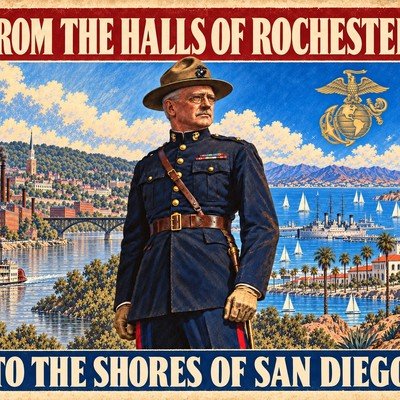
Then, in 1878, at eighteen, he left for the United States Naval Academy, and that was the end of his being predictable.
He graduated in 1882 and was commissioned a second lieutenant in the Marine Corps in 1884. The boy from the riverbank was soon learning the geography of oceans—first aboard the Pensacola, then in the Bering Sea aboard the Al-Ki.
The Spanish-American War found him aboard the USS Yankee at Santiago. Local accounts credit Pendleton with ordering the bombardment of Spanish positions and firing the last American shot of the engagement. The concussion of his own guns detached the retina in his right eye, which is one way to be decorated and injured by the same cannon.
A sensible man might have taken the hint. Pendleton did not. He made captain in 1899 and major in 1903—the same year a medical board tried, and failed, to retire him because of the eye. Assignments followed in the Philippines, Guam, and Puget Sound.
In 1912, he commanded Marines and bluejackets against supposedly impregnable positions at Coyotepe and Barranca Hill in Nicaragua. His men took them in thirty-seven minutes, then occupied León. Four years later, in the Dominican Republic, Pendleton commanded the 2nd Provisional Brigade, fought at Las Trencheras and Guayacanas, accepted the surrender of Santiago, and served as acting military governor. He received the Navy Cross and Distinguished Service Medal.
When America entered World War I, Pendleton asked to go to France. He was kept in Santo Domingo instead.
Even generals lose arguments with headquarters.
His real legacy, however, was an idea, not a battle. In 1914, while commanding the 4th Regiment in San Diego, Pendleton decided that the Marines needed a permanent West Coast
base—a place to keep men, weapons, and boats ready for whatever the Pacific and Latin America might require.
He had grown up watching a town's fortunes rise and fall according to its location on the Ohio. San Diego was simply the same lesson on a larger map.
So Pendleton campaigned. He gave speeches, lobbied headquarters, courted Congressman William Kettner, and used the 1915 Panama-California Exposition to advertise the cause. Persistence became policy. The 2nd Advance Base Force was established at San Diego in 1919 under his command. In 1921, it became the Marine Advanced Expeditionary Base. By 1924, it was Marine Corps Base, San Diego—later Marine Corps Recruit Depot San Diego.
Pendleton had put the Marine Corps on the West Coast for good. He retired on his sixty-fourth birthday in 1924, after forty years in uniform. The Marines affectionately called him "Uncle Joe."
Pendleton settled in Coronado, served on the school board and city council, and was mayor from 1928 to 1930. He remained restless, supporting Henry George's Single Tax movement until the end.
He died at home on February 4, 1942. Later that year, the Marine Corps acquired the sprawling Rancho Santa Margarita y Las Flores and named its new base after him.
He never saw it. He had spent years arguing that the Marines needed a permanent foothold on the West Coast, and the bulldozers arrived only after he was no longer around to watch them work. It is a peculiar kind of vindication, being right just late enough to miss the party.
A historical marker stands today in Veterans Memorial Park in Rochester. It is a modest thing for a man with a Marine base named after him, which seems about right for a town that never much believed in making a fuss.
Before the general, there was a boy on Pennsylvania Avenue. Before San Diego, there was a river town that already understood what a good location was worth. The Marines remember the general. California remembers the base. Rochester, having gotten him first, remembers the boy —and does not feel the need to say much more about it.
Embrace early fall in Beaver County with aimless drives, fresh cider, and unexpected discoveries. Adventure awaits just beyond your familiar routes.

Art’s evolution from craftsmanship to the realm of theory raises questions about value and authenticity, blurring the line between creator and critic.