The Village You Just Drove Through
Rowetown’s history is a tapestry of community life, where ordinary intersections held significance, now faded yet vital to understanding our past.


Rodger Morrow
Editor & Publisher, Beaver County Business
Editor & Publisher Beaver County Almanac Beaver County has produced a good many people who got very good at one thing.
Joe Namath threw footballs. Mike Ditka caught them, and later yelled at people who didn’t. Henry Mancini wrote music. Christina Aguilera sings it. This is the usual arrangement, and civilization depends on it. Most of us pick one thing and leave the rest of human knowledge to somebody else, who is presumably grateful.
Matthew Stanley Quay seems to have missed the meeting where this was explained.
Quay, who lived at College Avenue and Second Street in Beaver, is remembered mostly as one of the great political bosses of the Gilded Age. This is a little like remembering Leonardo da Vinci as a man who was handy with a paintbrush.
He was a boss, all right. He may have been the boss of Pennsylvania, running patronage, legislators, conventions, and the Republican Party with a quiet efficiency that sent reformers reaching for the smelling salts. He went to the U.S. Senate in 1887, and the next year he ran the Republican National Committee for Benjamin Harrison, who won.
Harrison credited his victory to Providence. Quay is said to have felt Providence was getting more than its share.
Politics, though, was only one shelf in the Quay library.
He graduated from Jefferson College, now Washington & Jefferson, at 17. He taught school in Mississippi, read law, and became Beaver County’s prothonotary. In the Civil War, already mustered out and sick, he went back on his own to fight at Fredericksburg and joined the doomed assault on Marye’s Heights. It eventually got him the Medal of Honor.
After that he owned and edited a newspaper, the Beaver Radical. Then came state government, then national politics.
Most people would call that a full schedule.
Quay went home and read Horace.
In Latin. He read Horace, Cicero, and Pliny in the original, reportedly wrote to Gov. Samuel Pennypacker in Latin, and talked Italian poetry with Theodore Roosevelt. He read Homer, Virgil, Dante, Shakespeare, and Longfellow. He read biography, Norse mythology, heraldry, church history, political economy, folklore, and colonial documents. It was said he knew how to keep silent in fifteen languages, a skill still in short supply in Washington.
The books went where he went.
He kept libraries at his home in Beaver, his house in Washington, and his retreat in Florida. He had a standing order with a Philadelphia bookseller for anything on folklore. He took books on trips, including fishing trips, which tells you something about either the books or the fishing. He and Henry Cabot Lodge were reportedly the only senators who subscribed to Alexander Brown’s Genesis of the United States, which suggests either rare intellectual curiosity or a Senate book club with an attendance problem.
The best story is from 1889.
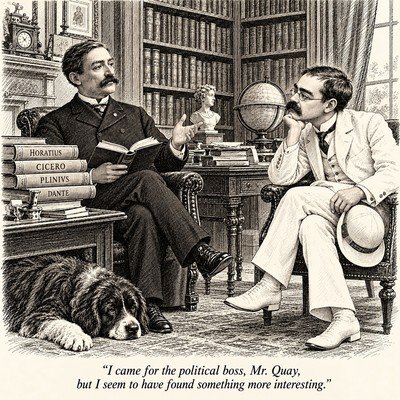
Rudyard Kipling came to Beaver, officially to visit the family of R. T. Taylor, president of Beaver College, and unofficially to get a look at the famous American political boss. He got his look. It was not what he expected.
They talked about books.
The talk wandered through literature and the classics. Kipling translated an Arabic inscription on a sword in Quay’s house. Quay sized up Kipling and predicted that, if the young man lived, he would rank among the great English writers. Kipling had come to see Boss Quay and reportedly left more interested in Quay the reader.
Picture it. Kipling arrives braced for an American political operator in a fog of cigar smoke, ward heelers, and envelopes fat with job requests. Instead he finds a man who wants to talk about Latin. This could have happened in a lot of places. It happened in Beaver.
None of this makes Quay a plaster saint.
His machine was powerful, ran on patronage, and was bitterly controversial. In 1898 he was indicted on charges of misusing state funds. He was acquitted. Reformers considered him the living embodiment of everything wrong with machine politics. Admirers considered him a genius. Both sides agreed he was formidable.
What gets lost is the range of the man.
Quay left no great book behind. No Horace in English, no treatise on Dante. His surviving papers are almost entirely political. His scholarship happened in private, nearly out of sight, in rooms lined with books.
In 1901, near the end of his life, Quay said something few men in his line of work could have said with a straight face:
“I have many friends to remember; I have no enemies to punish.”
Three years later, dying at home in Beaver, he went back to his books one last time.
The house at 205 College Avenue is now a National Historic Landmark. The machine is long gone. The library was scattered. If there was ever a catalog, it’s gone too.
But the outline of the man remains.
Soldier. Lawyer. Editor. Senator. Boss. Classicist. Book collector. Linguist. Student of myth, poetry, history, economics, and folklore.
Matthew Quay spent his life acquiring power. What he seems really to have wanted was to know everything.
Of the two, that was the one he kept quiet about.
Rowetown’s history is a tapestry of community life, where ordinary intersections held significance, now faded yet vital to understanding our past.
This October, embrace the journey. Discover the hidden stories in the landscape as you make your way to the pumpkin patch. There’s more than meets the eye.