Nobody Asked the Town
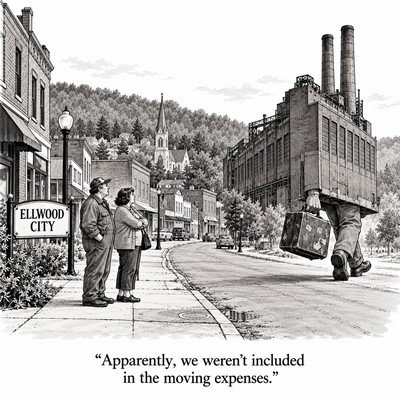
Ellwood City’s rise and fall highlights the fragility of communities built around industry, facing challenges when businesses relocate and priorities shift.



Rodger Morrow
Editor & Publisher, Beaver County Business
The most frightening thing about Halloween used to be an apple. You had become a pirate, negotiated several dark porches, and arrived expecting chocolate. An apple suggested the household had misunderstood the entire undertaking.
Now the adults have found more to worry about. Halloween, we are told, is pagan, satanic, and unfit for children, who belong at a harvest festival. A child dressed as a scarecrow may safely collect candy in a church parking lot, while the same child collecting the same candy on a neighbor’s porch has wandered into theological difficulties.
I suspect the parking lot is carrying more doctrinal weight than its builders anticipated.
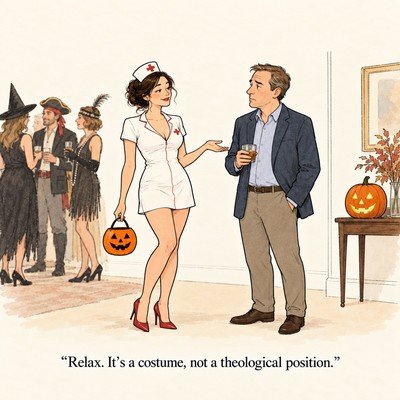
Before surrendering October 31 to the forces of darkness, consider the name. Halloween is short for All Hallows’ Eve, the night before All Saints’ Day. A hallow is a saint. The same root turns up in “hallowed be thy name,” which is not generally understood as an invitation to pagan worship.
The name has been explaining itself for centuries. Naturally, we have looked elsewhere.
Christians honored martyrs collectively by the fourth century, long before the first seasonal costume store. In 609, Pope Boniface IV dedicated Rome’s Pantheon to Mary and the martyrs. The November 1 observance developed in the eighth century and spread more widely in the ninth.
There were more saints than days on the calendar, a scheduling problem most organizations would have handed to a committee. The Church provided one feast for them all, including the ones never famous enough for their own stained-glass window.
November 2, All Souls’ Day, brought prayer for the faithful departed. Death was already on the calendar. It did not arrive with the inflatable skeleton.
Medieval Christians, less squeamish than we are, used images of skulls and skeletons as reminders that life had an expiration date, even if the manufacturer declined to print it on the package. Memento mori: remember you must die, and behave accordingly.
We have largely replaced this with the hope that the matter can be postponed through sensible eating.
Not every Halloween custom was personally approved by a pope. History is untidy, as it generally gets when people participate in it. Celtic Samhain traditions contributed, as did folk belief, mischief, and commercial ingenuity. Halloween is neither a perfectly preserved pagan ceremony nor a parish event that somehow acquired a fog machine.
Any church fundraiser demonstrates that sacred purposes can coexist with activities whose biblical authorization remains elusive.
In the old custom of “souling,” people went door to door offering prayers for the dead in exchange for soul cakes. Trick-or-treating has other ancestors, but the family resemblance is plain: somebody knocks, somebody answers, and something edible changes hands.
The modern child omits the prayers. He is working under a tighter schedule.
Kendra Tierney Norton, who writes on Catholic family life, argues that Catholics need not be scared off Halloween by people suspicious of Catholicism itself. Some Protestant opposition did begin as objection to Catholic doctrine, a dispute deserving better than the annual announcement that a plastic pumpkin is an occult instrument.
Her family carves pumpkins, wears costumes, and trick-or-treats while declining what it finds objectionable. That takes judgment, which beats condemning a date.
A family may skip gruesome decorations, nasty films, or costumes apparently designed by someone who ran out of fabric. None of that requires declaring that the child next door has imperiled his soul by dressing as a fireman.
Actual occult worship is another matter, and Christians can reject it on October 31, November 12, or an ordinary Tuesday. The calendar grants evil no special franchise for one evening, nor should faith act as though it does.
It is peculiar to proclaim Christ’s victory over death all year and then be unnerved by a bedsheet with eyeholes. The child underneath is mostly worried about seeing the steps.
In Beaver County, Halloween still does what committees spend good money trying to do: it gets people out among their neighbors. Porch lights come on. Adults admire costumes they cannot identify. Children practice saying thank you, sometimes after a reminder delivered through clenched parental teeth.
We ought to keep that without settling the relationship between medieval Christianity and pre- Christian Ireland before buying the miniature Snickers.
Ellwood City’s rise and fall highlights the fragility of communities built around industry, facing challenges when businesses relocate and priorities shift.
In Cannelton, the legend of the Pig Lady endures, blending history and folklore, reminding us that every ghost story has a human heart.