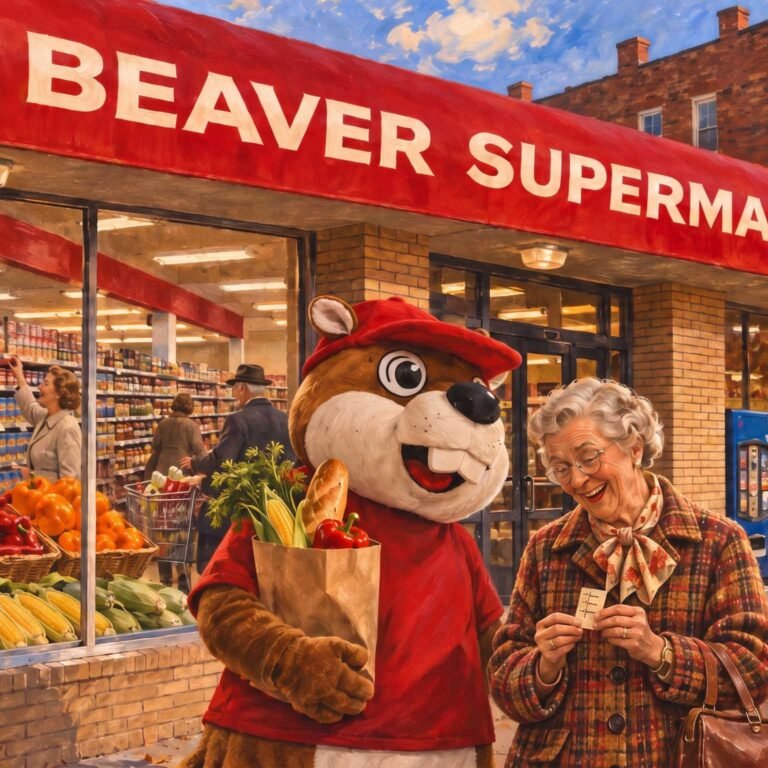
The Last Grocer on Third Street
Beaver Supermarket, the last independent store in the county, faces challenges but remains a vital community hub. Support local and shop small this season.


Rodger Morrow
Editor & Publisher, Beaver County Almanac
How a Czech celebration crossed Texas and found a place at Beaver's breakfast table.
The kolache had to go from Central Europe to Texas before anybody thought to bring it to Beaver. This is a roundabout way to reach Third Street, but food, like luggage, rarely takes the connection you would have chosen.
What matters is that it got here.
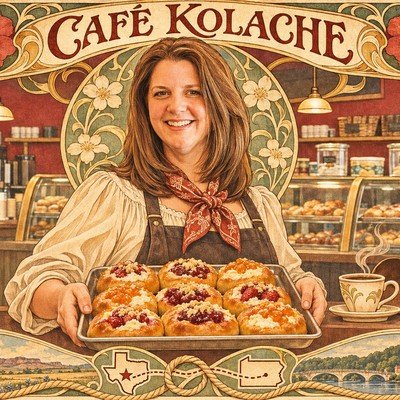
I have eaten at Cafe Kolache often enough to count myself among the beneficiaries of this geographical confusion. Since 2003 it has been feeding Beaver a pastry whose history takes in immigration, farming, weddings, sausage, corporate banking and the collapse of Enron.
Few breakfast foods have survived so much economic development.
The original kolache came from Bohemia and Moravia, where people discovered that a soft round of slightly sweet yeast dough could be improved by putting something in the middle. Poppy seed, sweet cheese, prune butter and apricot became the traditional fillings.
This was a sound civilization.
The name comes from a Slavic word for wheel, or circle. The pastry belonged to weddings, holidays and other community occasions. You baked kolaches because something important had happened and people were coming over.
America eventually extended this principle to Tuesday.
There is also a problem of grammar. In Czech, koláč is one and koláče is several. Americans borrowed the plural, used it as a singular and added an "s" when they wanted more.
This is how English acquires vocabulary. We invite a word into the country and immediately start moving its furniture.
The pastry's American journey began in earnest with Czech immigration to Texas in the nineteenth century. Settlers came for cheap farmland and chances they could not get at home. Many were Moravians. They settled around places like Fayetteville, Schulenburg, Caldwell and West, and brought their churches, language, music and recipes.
Other Central Europeans went other ways. Slovak immigrants helped man Pennsylvania's mills and mines while Czech farmers worked Texas soil. The two histories are related, but they are not interchangeable, however tempted Americans may be to file everybody under "grandmother's cooking."
For decades, kolaches stayed mostly in home kitchens, church halls and family gatherings.
A recipe could preserve something a passport could not: the feeling that the place you had left still existed somewhere, preferably within reach of the coffee.
Commercial bakeries widened the audience. The Village Bakery in West, opened by the Montgomery family in 1952, carried kolaches beyond Czech celebrations to travelers who had not realized until then that their trip required apricot.
Then Texas did what Texas generally does with a promising idea.
It added meat.
The klobasnek wraps sausage in a cousin of the sweet dough. Cheese and jalapeños soon joined it. Many Americans call these sausage kolaches, though traditionalists insist on the difference between the sweet, open-faced pastry and its closed-up savory relative.
The traditionalists have a point. So do the people holding the sausage.
Immigrant cooking has always been a negotiation between memory and what the grocery store has on hand. A recipe that had crossed the Atlantic was not going to faint at the sight of a jalapeño.
Which brings us, by way of Texas, to Kristi DeMaiolo Harper.
She met the kolache in the early 1990s, starting a career in corporate banking in Texas. Somebody brought a dozen to the office. This did more for the place than most proposals for improving productivity.
She took to serving kolaches to visiting friends and family, and joked that if she ever moved back to Pennsylvania she would have to learn to bake them.
The events of 2001 turned the joke serious. The September 11 attacks and the collapse of her employer, Enron, set her to thinking about family, work and the kind of daily life she wanted. Her answer was a cafe meant to be both a good place to work and a place for the town to gather.
There is something reassuring in that career change. After Enron, a business in which the dough actually has to rise has its advantages.
At 402 Third Street, the menu makes a good case for the long trip.
The breakfast kolaches hold what you would expect to find on a breakfast plate: eggs, bacon, sausage, ham, cheese and potatoes. The lunch versions run to meats, vegetables and cheeses. Fruit and cream kolaches keep up the pastry's sweeter calling. There are also soups, salads, an espresso bar and locally roasted coffee.
The appeal is the idea underneath: slightly sweet bread that either carries something savory or supports something sweet. The customer gets choices without having to adopt a new theory of breakfast for each one.
A newcomer might sensibly order one savory kolache and one traditional fruit or cheese. That lets the old country and Texas each speak for themselves.
The coffee can interpret.
Over the years Cafe Kolache has become an ordinary part of Beaver rather than an expedition into foreign food. That is no small thing for a pastry whose name still needs explaining now and then. A place becomes part of a town when people stop talking about its novelty and start arranging to meet there.
The gathering-place ambition matters. A town needs places where buying breakfast entitles a person to sit among other people for a while. We have invented any number of clever ways to connect electronically, and we still need somewhere to sit down.
Cafe Kolache opens at six on weekdays and seven on Saturday, and closes at two. Sunday it keeps for itself.
The kolache began as food for an occasion. In Beaver it offers the modest possibility that breakfast might become one.
After crossing an ocean and detouring through Texas, it has earned its chair. So, on a good morning, have I.
Cafe Kolache is at 402 Third Street in downtown Beaver, PA 15009. Hours are Monday through Friday, 6 a.m. to 2 p.m., and Saturday, 7 a.m. to 2 p.m.; closed Sunday. For menus, catering, or information about the meeting room, visit cafekolache.com or call (724) 775-8102.
Beaver Supermarket, the last independent store in the county, faces challenges but remains a vital community hub. Support local and shop small this season.

Dining out has become a luxury, with couples weighing costs more than ever. As budgets tighten, the romance of a simple dinner now demands deeper consideration.