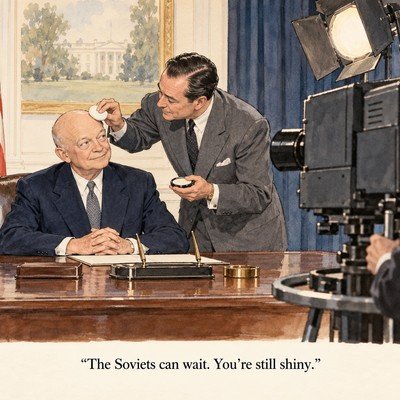
The President Will See You After Makeup
Presidents Eisenhower, Nixon, and Reagan mastered the art of television, learning to connect with viewers and communicate effectively in a new era.



Rodger Morrow
Editor & Publisher, Beaver County Almanac
Among the roads of western Pennsylvania, which appear to have been laid out by men pursuing animals rather than destinations, there is one near Cannelton that enjoys a reputation far beyond its usefulness. By daylight it carries the traveler through a country of wooded hills and farms, beside a creek that has never agreed to run straight. It wanders among the alders like a schoolboy on an errand he has no wish to finish. After sundown, according to persons whose testimony grows more emphatic as the hour grows later, the road carries him into circumstances for which no county commissioner has been willing to answer.
It was along this road, in a year when Cannelton’s coal trade belonged to expectation rather than accomplishment, that Mr. Absalom Quill undertook to correct the inhabitants’ understanding of the invisible world.
Mr. Quill was a surveyor’s assistant, a bachelor, and a man of information upon subjects from which he derived little income. He had come west with a brass compass, three shirts, and a conviction that the countryside would improve as soon as it was properly measured. His face was narrow, his whiskers apportioned, and his legs so long that, seated upon a fence, he looked as though he had been hung there to dry. He distrusted everything that could not be entered in a notebook, saving only the favorable opinions he held of himself.
His employer had sent him to examine properties near the old workings, where coal showed itself in dark seams along the hillsides. He took lodging with the Widow Pritchard, whose house afforded meals, a feather bed, and more conversation than he had contracted for. The widow’s niece, Mercy Bell, lived with her. Mercy was a damsel of gray eyes and of that troublesome sort of beauty which seems wholly unaware of its effect. She possessed an inheritance, a constitution, and the rare ability to hear a foolish remark without encouraging its repetition.
Quill considered her an argument for remaining in the district.
He was not alone in this conclusion. Gideon Rusk, whose father owned a farm, had arrived at it without taking any notes at all. Gideon was broad in the shoulder, sparing of speech, and acquainted with every road, creek, and loose fence rail for miles around. He could mend a wagon, quiet a frightened horse, and converse with Mercy without selecting a subject from a book. Quill regarded these accomplishments as provincial. Mercy appeared to regard them with charity.
The rivalry came to a head at the Widow Pritchard’s autumn supper. The company had assembled ostensibly to celebrate the harvest and actually to discover who had prospered, who had quarreled, and whether the widow’s preserves had justified their expense. The table, I am assured, groaned in the manner. There were hams and fowls, a platter of buckwheat cakes, apple butter in crocks, pickles of persuasion, and pies whose crusts had been crimped by an artist. In the midst of all stood the preserves, glowing like stained glass and awaiting judgment.
The company ate until the kitchen windows clouded over, and then drew about the fire. Without, the moon rose through a gauze of cloud. Within, the cider went round, the chairs creaked, and the talk advanced by its stages: from weather to crops, from crops to deaths, and from deaths to those persons who had neglected to remain properly dead.
At this last subject, Mrs. Pritchard glanced toward the window. “Barbara walks on a night like this,” she said.
Quill smiled the patient smile with which he received information from people who had never owned a compass. “Does she indeed?”
Nobody answered. Even Gideon, who had been dividing an apple with his pocketknife, closed the blade.
The story of Barbara Davidson was not told in that neighborhood as strangers tell a curiosity. There were families who claimed to remember her people. There were old women who repeated what their mothers had heard. And there were places in the woods where conversation fell quiet without anyone having agreed that it should.
Barbara, so the account ran, had been a young woman on her parents’ farm in the summer of 1795. She sang at her work, handled a rifle with competence, and kept the creatures entrusted to her with a tenderness that did not prevent her from making them behave. When her parents went down to Pittsburgh for supplies, they left her in charge. On their return, she had vanished. Days afterward, the search ended beneath the house. Her body was there. Her head was not.
Of the hand that had done this, nothing certain survived.
At first, it was said that she walked without a head. In time, other accounts arose. A shape came up out of the river mist. A woman was heard weeping near a bridge. Horses shied upon an empty road. And at length, in certain tellings whispered by the boldest boys, the wandering woman had found herself another head.
“A pig’s,” said young Lemuel Pritchard from behind his mother’s chair.
His mother sent him for more wood.
“An instructive development,” said Quill. “Observe how an imperfect account acquires particulars.”
Old Mrs. Aiken had seen many more imperfect accounts than he had. She regarded him over her spectacles. “Observe how a young man acquires confidence,” she said.
Mercy bent her face to her sewing.
Quill mistook the movement for admiration and proceeded. Vapors, he explained, were common near running water. Animals frightened themselves. Darkness distorted proportion. And the mind, when prepared by expectations, supplied whatever the eye omitted. As for a woman wearing a pig’s head, the proposition was contrary at once to anatomy, theology, and ordinary husbandry.
Gideon turned his apple in his hand. “You have never seen her, then.”
“Certainly not.”
“Nor gone looking?”
“I do not go looking for things that do not exist.”
“That saves walking,” said Gideon.
The company received this with an appreciation Quill thought excessive. To recover his standing, he announced that he would cross the ground at midnight, provided someone would identify it with accuracy. Indeed, as he had measurements to complete beyond the creek, he would do so the next evening. He made this declaration while looking at Mercy.
Mercy considered him for a moment. “Take a good lantern,” she said.
It was not precisely the encouragement he had sought.
By the next day, the neighborhood knew of his expedition. Men who had never shown the interest in surveying stopped him in the road to ask when he meant to set out. Boys followed him at a distance, like crows behind a plow. A good woman pressed upon him a packet of salt. He declined it on scientific grounds, and afterward slipped it into his pocket when she was not looking.
Gideon offered his mare. “She’s steady,” he said, “unless you pull her mouth too much.”
Quill refused. Walking afforded better opportunities for observation, and he would prefer not to have the behavior of an animal confused with his own.
Gideon nodded. “Animals do make distinctions difficult.”
Toward evening, a low fog gathered along the creek. The hilltops stood clear against a cold sky, but the hollows looked as though someone had poured milk into them. Quill supped lightly and consulted his watch three times. Then he set forth with his lantern, his measuring chain, his notebook, and a walking stick of sufficient weight to discourage anything that might happen to exist.
Mercy stood in the doorway. “If you hear somebody calling,” she said, “be sure it is somebody.”
He laughed. It was a laugh upon the doorstep. Fifty yards down the road, he began to wish she had phrased her farewell differently.
For the first mile, his spirits remained excellent. He identified an owl, dismissed a moving shadow, and entered in his notebook an observation upon the influence of darkness on uneducated minds. Then his lantern revealed something white standing among the trees.
It was a shirt hung upon a branch.
He examined it with indignation. Somebody, he concluded, meant to make sport of him. He struck the garment with his stick and resumed his walk, taking no small satisfaction in the vigor of the blow.
At the creek crossing, the satisfaction began to diminish.
There was a sound beyond the water. It might have been a woman singing; it might have been the current passing under the bridge. The tune, if tune it was, consisted of a few notes only. They were repeated with such gentleness that he leaned forward to hear them better, before recollecting that he was not interested.
“Water,” he said aloud.
The singing ceased.
Quill stood still. His lantern smoked. Some way up the far bank, something stirred in the brush, and from it came a low and unmistakable grunt.
This was reassuring. Pigs were within his system.
“Come out, then,” he said, with authority.
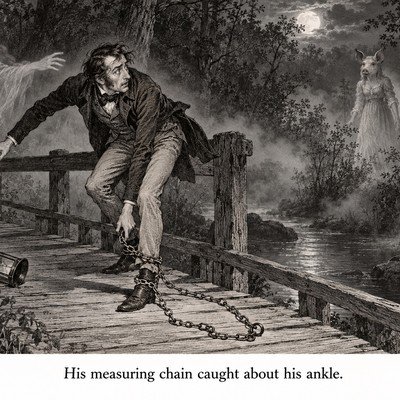
The shape that emerged was taller than a pig. It stood upon the bank, where the mist rose among the alder branches. At first, Quill made out the pale breadth of a skirt. Then he saw shoulders, an arm, and a head that seemed to turn without any movement of the body. His lantern did not reach it. Nevertheless, he distinguished a projecting snout and two upright ears.
There are moments when an educated man’s conclusions undergo rapid revision without being formally withdrawn.
Quill stepped backward. The figure remained where it was.
“Who are you?” he demanded.
The answer, if answer it was, came like a breath across the water: “Barbara.”
A man might have suspected an accomplice concealed in the bushes. Quill did suspect one. Unhappily, he suspected Barbara also.
He raised his stick. The figure lifted one hand. Behind him, on the bridge, a board cracked.
Quill turned so suddenly that the lantern swung against the railing and went out.
The darkness that followed was not an absence of light. It seemed to him a substance, and plentifully supplied.
He heard the singing again, near.
His measuring chain caught about his ankle. He stooped to free it and felt something touch his shoulder. He gave utterance to a sound that was afterward variously described as a cry, a prayer, and the call of some bird unknown to the district.
He ran.
Of that retreat he kept disconnected particulars. There was a gate that was not where a gate ought to be. There was a bramble that conducted itself like an intentional obstacle. And there was the astonishing distance that lies between a man and a house when the man has urgent need of the house.
At last he saw a light through the trees. It came from Gideon Rusk’s barn.
Quill burst through the door, stumbled over a bucket, and fell against a hanging harness, which came down upon him with metallic reports. A sow in the pen awoke and expressed her displeasure.
Gideon appeared with a candle. For a moment he surveyed his visitor, who lay beneath the equipment with one leg protruding like a surveyor’s rod.
“Have you finished measuring?” he asked.
Quill demanded assistance, and then brandy. Gideon supplied water, removed the harness, and listened while his guest explained that a deception had been practiced upon him.
“A woman?” Gideon asked.
“Yes.”
“With a pig’s head?”
Quill hesitated. “With something intended to represent one.”
Gideon looked toward the pen. The sow looked back.
“Most representations are poor,” he said.
By morning Quill’s adventure enjoyed a circulation exceeding that of his remarks upon vapors. He maintained that he had detected a conspiracy. His flight, he explained, had been an effort to procure witnesses. The loss of his lantern and notebook was incidental. The noise heard at the bridge had been a signal. Nobody could determine whom he had intended to signal.
Mercy brought him his breakfast. She listened, examined a scratch upon his forehead, and observed that he ought to have accepted the horse.
“The horse might have been deceived,” he replied.
“Yes,” she said. “But you would have arrived sooner.”
Before noon, however, something occurred to disturb even those most disposed to laughter. Lemuel Pritchard came home carrying Quill’s notebook. He had found it near a stone foundation beyond the creek, in a spot Quill insisted he had never reached. Inside lay a strip of blue cloth. On the last page, beneath Quill’s observations, someone had written a name.
Barbara Davidson.
Quill studied the letters a while. The pencil was his own. He declared that some person must have taken it.
Mrs. Aiken said nothing, but laid the cloth upon the mantel.
Gideon was summoned and questioned. He owned to having been near the creek that evening, but said he had gone after a pig that had wandered. Asked whether he had seen a woman, he answered that there were a great many things a person might see in a fog. This explanation pleased nobody, though several thought it adequate.
There was also a report that Mercy had been absent from the kitchen for half an hour before Quill’s return. She said she had gone to visit Mrs. Aiken. Mrs. Aiken confirmed it, but could not recollect when the visit began.
The white shirt belonged to Lemuel. The voice, he said, did not.
Quill departed three days later. His employer received a report pronouncing the land unsuitable for enterprise, by reason of poor drainage, uncertain boundaries, and an unreasonable population.
Mercy and Gideon were married the following spring. It was remarked that Gideon never told the story at his own table. When visitors recounted Quill’s adventure, though, he would sometimes smile in the wrong places, and Mercy would look at him until he found other employment for his face.
Years passed. The coal workings grew, men came and went, and the road became busier without becoming any less dark. Quill’s name survived chiefly as the explanation for a deep rut near the Rusk gate.
Barbara’s name survived differently. Mrs. Aiken kept the blue cloth until her death, and those who examined it found nothing remarkable beyond its age and a smell of lavender. The handwriting in the notebook resembled Quill’s own, though he denied it with the vigor men reserve for troublesome resemblances. And there were later travelers who heard a woman singing where no house stood, or saw something pale among the alders, or came home by another road without caring to explain their choice.
Perhaps Gideon borrowed a disguise, and perhaps Mercy lent him her help. Or perhaps a lonely woman crossed that night from one kind of darkness into another. I cannot pretend to say. I had the account from a gentleman who knew the road and had never in his life trusted a surveyor. He told it beside a fire. When I proposed that we walk out to the bridge, he replied that daylight would show us everything necessary.
I found his judgment excellent.
Presidents Eisenhower, Nixon, and Reagan mastered the art of television, learning to connect with viewers and communicate effectively in a new era.
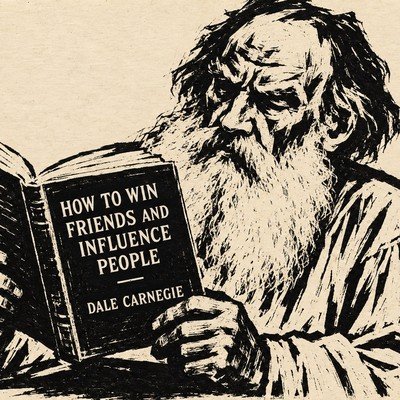
Improving oneself can unsettle those around you. Embrace your growth while staying true to your conscience, even if others resist the change.