
There Goes the Electric Bill
Beaver County faces a dilemma with new data centers, balancing economic potential against local concerns about infrastructure and environmental impact.



Rodger Morrow
Editor & Publisher, Beaver County Business
The trouble with a cookbook is that it assumes you know how to cook. This is a large assumption to make about someone who has just opened a book to find out how.
“Chop an onion,” it says, and moves on. It does not ask about your qualifications. You may be attacking the onion with a steak knife while it rolls toward the sink. The cookbook has already gone on to the shallots.
There is, of course, the old recipe for leek soup that begins, “First you take a leek …” This is clear enough when written down. Read aloud, it sends the beginner out of the kitchen altogether.

I suspect a great many disappointing dinners begin in this gap between what the instructions say and what the person holding the onion understands. We follow directions faithfully. Unfortunately, several of the directions require skills we have been hoping nobody would ask about.
Jacques Pépin noticed. In 1976 he published La Technique, a book that taught cooking through the work of the hands. Instead of recipes, it offered the operations on which recipes depend, with photographs showing what the knife should do, where the fingers belong, and what happens between buying a chicken and serving it to company.
This was an unusual contribution to publishing. Most books about self-improvement leave the hands unemployed.
It also challenged a comfortable household belief: that owning enough cookbooks will eventually make you a cook. The theory has strong support among people who sell cookbooks. Under it, competence accumulates on a shelf until the shelf needs reinforcing.
The attraction is plain. A handsome cookbook promises a better life. Its kitchens contain no mail. Interesting people gather around its tables without anyone first moving the laundry. In the background sits a bowl of lemons enjoying a standard of living beyond our own.
Then Tuesday comes. You have three eggs, half an onion, and something in the refrigerator that has lost its label.
This is where technique earns its keep.
A recipe tells you what to do with one particular set of ingredients. A skill travels. Learn to control heat, handle a knife, or tell when an egg has had enough, and you can take that knowledge into whatever supper the household budget permits.
Beaver County should find this congenial. People who could repair a furnace or keep a mill running would recognize the method at once: watch somebody do the job, then practice until
your hands understand it. Somehow we have made cooking less accessible by burying it under more instructions.
Start with the knife. Many of us use one as though the object were to make a vegetable confess. We press, saw, and finish with pieces bearing little resemblance to one another. The small ones burn while the large ones remain suitable for planting.
Pépin teaches control: a secure grip, fingertips tucked back, a slicing motion that lets the blade do the work. Even pieces cook evenly. A sharp edge spares you the labor of shoving a dull one through a reluctant tomato.
None of this requires speed. The television cook may dispatch an onion before you have found the cutting board. You are making supper. The onion has no other appointment.
Go slowly. Watch what you are doing. Keep your fingers.
Then consider the omelet, so familiar we have stopped expecting anything of it.
To many Americans an omelet is folded egg whose main duty is supporting cheese. Add enough ham, peppers, mushrooms, and potatoes, and the eggs become a sort of building permit.
Pépin demonstrates two. His country omelet has large curds and a browned outside. His classic French omelet, stirred rapidly, has tiny curds, a smooth, pale surface, and a soft center. He finds merit in both. The difference lies in the handling and in what you want on the plate.
This seems almost recklessly tolerant in an age when people end friendships over what belongs in chili.
The lesson is plain. The same eggs make different suppers because somebody understands what motion and heat will do to them. Expensive eggs will not supply that understanding. Neither will a pan endorsed by a man who shouts at restaurant employees.
Equipment has its uses. Still, it is pleasant to learn that the essential improvement may lie between the stove and your elbow.
Pépin goes on through vegetables, poultry, fish, and dough, and on into the elaborate accomplishments by which French cooks have long discouraged the rest of us. There are decorative flourishes, including an olive carved into a rabbit.
I admire the rabbit. I do not require it at lunch.
The practical work interests me more. Learn to cut up a chicken and you have choices about cooking its parts. Learn to handle vegetables efficiently and preparing them stops being an ordeal. Understand what a pan is doing and you may find that supper no longer requires constant consultation with a telephone.
That last point deserves attention.
The modern online recipe opens with several hundred words about the author’s grandmother, followed by advertisements, a plea to subscribe, and a video that follows you down the page. By the time you reach the oven temperature, you have formed opinions about a family you will never meet.
A little competence lets you put the telephone down.
It also lets you recover when life departs from the instructions. The onion is larger. The pan is smaller. The stove runs hot. Someone has eaten the ingredient on which the whole enterprise depended.
The experienced cook notices, adjusts, and proceeds. The obedient beginner stands among perfectly edible groceries, wondering whether dinner has become legally impossible.
Beaver County faces a dilemma with new data centers, balancing economic potential against local concerns about infrastructure and environmental impact.
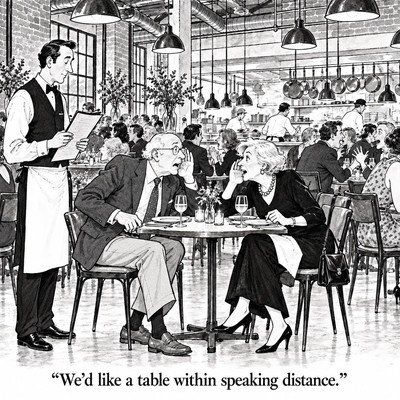
Dining out should be about connection, not chaos. As noise levels rise, so does the challenge of enjoying meaningful conversations over dinner.