
The President Will See You After Makeup
Presidents Eisenhower, Nixon, and Reagan mastered the art of television, learning to connect with viewers and communicate effectively in a new era.



Rodger Morrow
Editor & Publisher, Beaver County Almanac
Beaver County Almanac does not ordinarily undertake to explain France. We have enough trouble explaining Beaver County, where a man can live in one municipality, get his mail through another, and send his children to a school district named for something else entirely. France has ministries for this sort of confusion. We have people who remember where the old gas station stood.
Still, several readers have seen reports that Europe is coming apart and want to know whether Western civilization is finally ending. I would have preferred a question about a new restaurant.
The occasion is France, where demonstrations over living costs and the schools have come with looting and appalling destruction. In Limoges, the town hall, inaugurated in 1883, was set ablaze. Its roof burned, its spire fell, and it became the kind of spectacle people watch on their telephones while someone explains that everything is much worse than they thought.
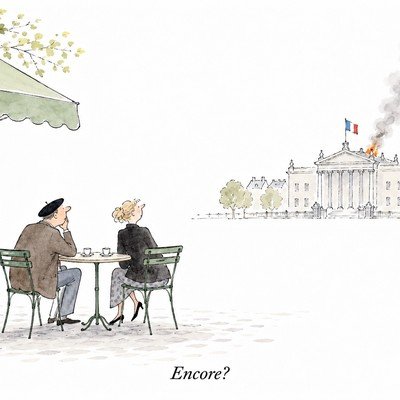
It is bad enough without the help.
Begin with a distinction. A teacher asking for decent classroom supplies is doing one thing. A masked man setting fire to a municipal building is doing another. Calling them both “protesters” gives the arsonist a professional credential he hasn’t earned. It also gives the teacher a terrible publicist.
Authorities reported at least 2,400 arrests, and President Macron blamed far-left radicals and criminals. That does not make every marcher an insurrectionist, nor does it make the insurrection imaginary.
Readers have sent me a grander theory. Dr. Steve Turley and former police inspector Paul Mauro describe a “red-green alliance” of revolutionary leftists and radical Islamists, with environmental radicals along for the ride, all joined in a common enterprise of destruction.
Such alliances are possible. Anyone who has served on a committee knows people can agree on what to tear down while postponing the question of what to build. But possibility is where an investigation begins, not where it ends. Proving an organized international operation takes particular organizations, money, instructions, and acts. A Palestinian flag in a crowd does not supply all four. Neither does naming a billionaire. An accusation ought to arrive with more luggage than a surname.
I would like answers that survive inspection by somebody who doesn’t already agree with me. This is an old-fashioned preference, but I’m trying to preserve a civilization here.
Immigration deserves the same seriousness. A country should control who comes in, enforce its laws, and expect newcomers to join a common civic life. Governments that treat those expectations as embarrassing prejudices should not be astonished when voters shop elsewhere for a government.
Borderless sovereignty strikes me as a bit like trying to play tennis with the net down. It makes getting the ball across considerably easier, but after a while somebody is bound to ask what game we are playing. Tennis has its origins in France, though the English later developed the modern lawn game. Between them, they appear to have understood that a net was part of the equipment rather than an insult to the visiting player.
But “immigrant,” “Muslim,” “French citizen,” and “rioter” are not interchangeable words, and little I have read establishes immigration as the definitive cause of this outbreak. A man’s ancestry cannot tell us whether he lit a fire, tried to put one out, or spent the night hoping his shop would survive. We should hesitate before trading individual responsibility for a system in which a man gets his verdict from his grandparents.
Beaver County knows something about this, having been built by other people’s grandparents.
They came to make steel in Aliquippa, bridges in Ambridge, and glass, pottery, and tin up and down the river. They came from Italy and Slovakia, Serbia and Croatia, Poland, Ukraine, and Greece, and from Alabama and Georgia in the Great Migration. The company sorted them into neighborhoods, and the neighborhoods built churches with onion domes and churches with bell towers and argued, in a dozen languages, about whose were better.
They were not always welcome. Plenty of people said these newcomers would never fit in. Their grandchildren now run the township meetings.
What made it work was not that anyone stopped being Italian, Serbian, or Slovak. Nobody at Ambridge’s Nationality Days ever gave up anything but an afternoon and a belt notch. What made it work was that a man could keep his church, his language, and his grandmother’s recipe for halupki and still be expected at the union hall, the ballfield, and the fire company, on time.
When a neighbor’s house caught fire, nobody first inquired into his cultural identity. Belonging meant something when the smoke appeared.
Katharine Birbalsingh, the British headmaster, asks the useful question: What are children being invited to belong to? A nation, she argues, cannot teach its young that their country is chiefly a criminal enterprise and then expect them to look after it. Teach only the achievements and you get a brochure; only the cruelties, an indictment.
Her alternative, “multicultural nationalism,” would be recognized at any Beaver County church festival: different faiths, foods, and family traditions under one shared allegiance. Our grandparents didn’t call it that. They called it Saturday.
Belonging must also deliver on an ordinary Tuesday: a school that teaches, a street where a business can open, work worth doing. The mills gave our immigrants something to belong to before anybody lectured them about belonging. A promised factory is not yet a paycheck, but it is easier to ask a young person to hold up a society that has saved him a place.
None of which excuses burning down the employment office.
The people living with the strain on housing, schools, and policing deserve answers, not a vocabulary lesson from celebrities on estates built to keep the public at a distance.
Disorder opens a door for Marine Le Pen, whom recent polling shows strong ahead of 2027. That is a possibility, not a result delivered early for the convenience of YouTube. Whoever
governs must protect peaceful assembly and prosecute violence, which takes judgment, a scarcer commodity than slogans.
So is Western civilization ending?
I would hold off on the obituary while people are still putting out fires and repairing shops. In Limoges, thousands turned out afterward to condemn the violence. The man carrying a broom never draws the camera like the man carrying a torch, but he may tell us more about what happens next.
From Beaver County, I can’t guarantee Europe’s future. I can suggest waiting before canceling that Viking river cruise.
Somebody will have to show up and fix the place, of course. Around here, that usually takes a dozen nationalities and a covered dish.
Presidents Eisenhower, Nixon, and Reagan mastered the art of television, learning to connect with viewers and communicate effectively in a new era.
Improving oneself can unsettle those around you. Embrace your growth while staying true to your conscience, even if others resist the change.