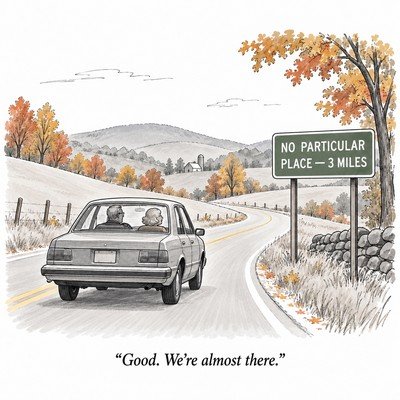
No Particular Place to Go
Embrace early fall in Beaver County with aimless drives, fresh cider, and unexpected discoveries. Adventure awaits just beyond your familiar routes.



Rodger Morrow
Editor & Publisher, Beaver County Business
The ham barbecue sandwich is one of the great culinary achievements of Western Pennsylvania, though "culinary" may overstate the training required.
You take chipped ham, drop it in a pan of reddish sauce, heat it, put it on a bun. A person of ordinary steadiness can manage it without consulting YouTube.
Nothing is smoked. No pit is dug. No hardwood is chosen by a bearded man speaking reverently of bark formation. The ham does not spend fourteen hours communing with hickory at a temperature known only to the pitmaster and God — it is warmed in sauce. We call it barbecue anyway, because "ham heated in ketchup" would have been a harder sell.
The sandwich begins with Isaly's, the dairy-store empire that gave Western Pennsylvania chipped chopped ham, Skyscraper cones, and the Klondike bar. Most companies are lucky to leave behind one thing people still remember. Isaly's left three.
Chopped ham was pieces and trimmings pressed into a loaf — less regal than a whole baked ham, considerably cheaper. Isaly's discovered that slicing it nearly transparent transformed the thing: "chipped chopped ham" came out tender, fluffy, seemingly abundant, a quarter-pound in butcher paper looking capable of feeding a Methodist youth conference. This was not deception. It was presentation.
Sometime in the 1930s, an Isaly's lunch counter or some ingenious home cook began simmering the ham in a thin, sweet-tangy tomato sauce. Isaly's eventually bottled its own, so anyone with a saucepan could reproduce the experience without a commute.
Heinz was the indispensable accomplice. In Western Pennsylvania, ketchup meant Heinz the way chipped ham meant Isaly's and football meant explaining to the television what the coach should have done. Bringing another brand into a Beaver County kitchen was less grocery shopping than denominational rebellion. Heinz sweet pickles finished the job, their crunch cutting the soft, saucy ham — on the bun or alongside, depending on whether the cook believed in separation of powers.
Then came the war, and after it the veterans, accustomed to Spam and other processed meats built to survive supply chains and possibly direct artillery fire. Chipped chopped ham seemed practically farm-fresh by comparison. The mills were hiring, families were growing, and women who'd spent the war doing essential work were not lining up to spend the peace roasting meat.
Ham barbecue arrived right on schedule: cheap, quick, hard to ruin, easy to multiply. Six unexpected relatives, add more sauce. Twelve, add more buns. The whole choir, send somebody back to Isaly's. The soft hamburger bun was essential — a crusty roll would have introduced resistance the sandwich wasn't built to survive.
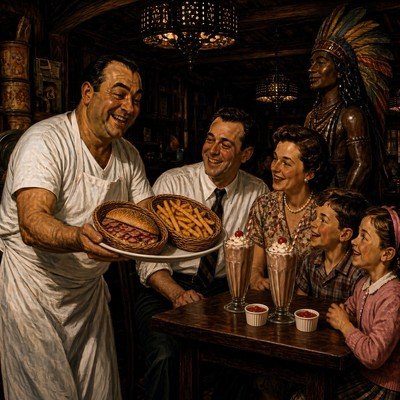
In Beaver County, Bert and Julie Sebastian made the sandwich an institution. They opened the small restaurant in 1948 that became Bert's Wooden Indian, and served ham barbecue there across generations, until it grew hard to say whether Bert and Julie had popularized the sandwich or the reverse. Isaly's supplied the regional idea. Bert and Julie gave it a permanent address.
Soon it was everywhere — reunions, graduations, church suppers, fire-hall fundraisers, funeral dinners. It suited funerals especially well, since it could be made ahead and eaten while the room discussed the deceased's better qualities.
Every family had a sauce, and every cook insisted hers was the authentic one — "authentic" meaning "the way my mother made it." Ketchup, vinegar, brown sugar, mustard, Worcestershire; some added onions or celery, others a bottle of cola. Whatever went in, a little chipped ham stretched across children, millworkers, neighbors, and whichever cousin turned up just as supper hit the table.
It was democratic food. No wine pairing, no special fork, no anxiety about ordering it wrong. Nobody asked if the ham was locally sourced or the ketchup had notes of oak. You picked it up, leaned forward to spare your shirt, and accepted the sauce that got away.
Ham barbecue has outlasted changing diets, vanishing Isaly's stores, mill closings, and foods that require the waiter to explain them. It's still on the menu at Bert's Wooden Indian, and in the kitchens of people who understand that feeding a crowd need not require a culinary degree or a home-equity loan.
The sandwich belongs to an era when food was expected to be filling, economical, and on the table before everyone turned disagreeable. It asked little of the cook and nothing of the guest but a tolerance for dripping sauce.
Beaver County didn't invent chipped chopped ham. It did something more useful.
It put it to work.
Embrace early fall in Beaver County with aimless drives, fresh cider, and unexpected discoveries. Adventure awaits just beyond your familiar routes.

Art’s evolution from craftsmanship to the realm of theory raises questions about value and authenticity, blurring the line between creator and critic.