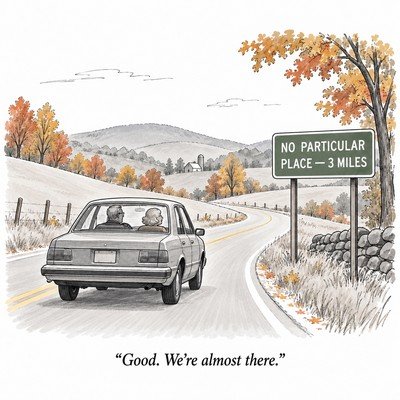
No Particular Place to Go
Embrace early fall in Beaver County with aimless drives, fresh cider, and unexpected discoveries. Adventure awaits just beyond your familiar routes.

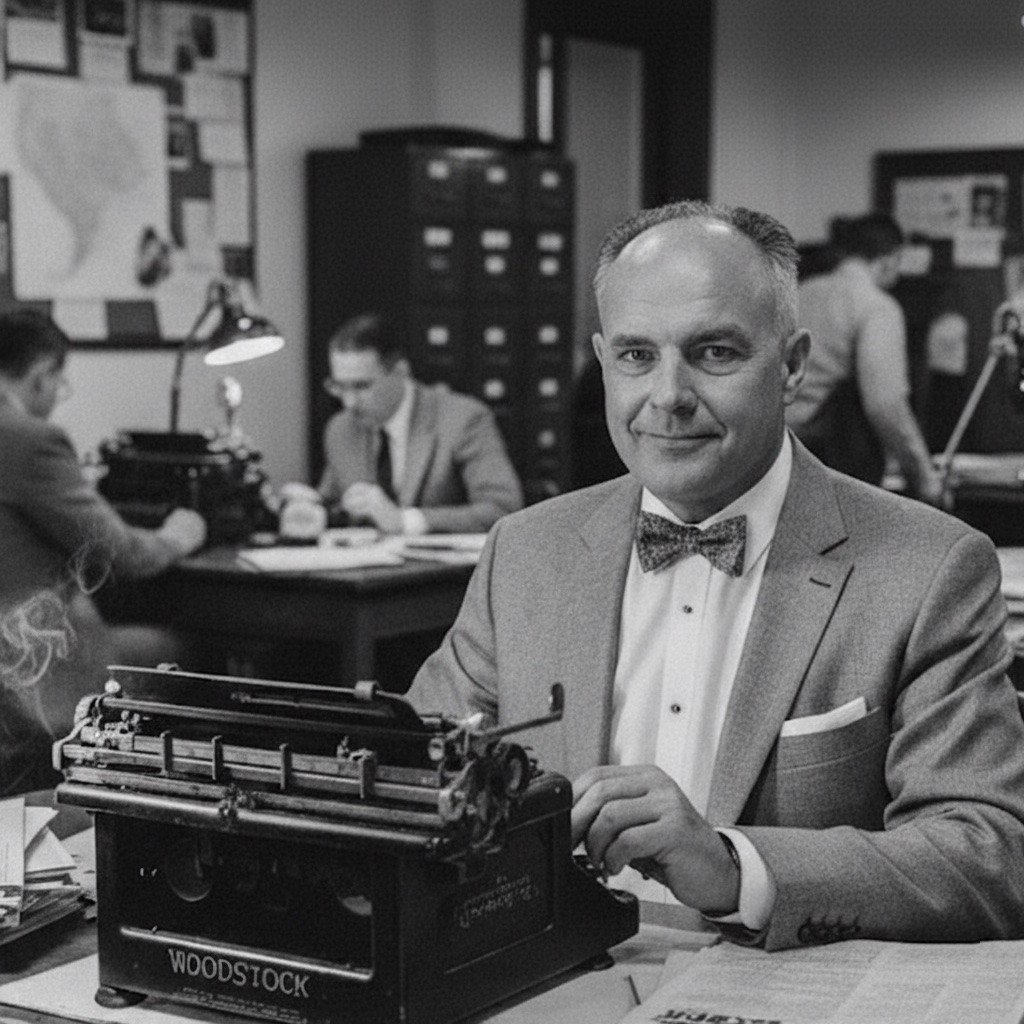
Rodger Morrow
Editor & Publisher, Beaver County Business
It simply occurred to young Americans after World War II that a car, some gasoline, and no particular place to go were all the evening’s entertainment a person required.
Beaver County was ready. It had mill wages, mechanically inclined young men, cheap used cars, drive-in restaurants, and enough long streets to let a fellow pass the same girl six times without admitting he was lost.
Cars arrived early. In 1902, Beaver County had 22 registered automobiles, which meant every owner knew the other 21 and disapproved of their driving. By 1908, Beaver Falls Old Home Week featured a 25-mile race beginning at Seventh Avenue and Fourth Street: B.O. Fair’s supercharged Maxwell against Howard McCreery’s Buick. Police were already chasing speeders—proof that traffic enforcement arrived with the automobile and has been several car lengths behind ever since.
Modern car culture waited for the veterans. They returned knowing how to repair aircraft engines, tanks, and trucks, and found mills hiring, suburbs spreading, and Detroit eager to sell every family a new car every year. Detroit called this planned obsolescence. Teenagers called it a cheap used Ford.
Southern California supplied the style. Young men stripped down Model Ts and As, installed larger engines, painted on flames, and raced across dry lake beds. Boulevards such as Van Nuys and Whittier became rolling theaters where cars moved slowly enough for the chrome to be admired.
Journalist Tom Wolfe found a name for the object of this devotion: the “kandy-kolored tangerine-flake streamline baby.” Ordinary spelling could not contain metallic paint, chrome pipes, rolled-and-pleated upholstery, and an engine capable of rattling the windows at Isaly’s.
The Beach Boys, Jan & Dean, Chuck Berry, and a small army of harmony groups supplied the soundtrack. They sang about hot rods, drag strips, little old ladies with Super Stock Dodges, and the urgent need to get around. Beaver County was several thousand miles from Malibu, but with the windows down and “Little Deuce Coupe” on the radio, Darlington Road could briefly pass for the Pacific Coast Highway—provided nobody looked for the ocean.
Beaver County had no Van Nuys Boulevard, but it had Seventh Avenue in Beaver Falls, Franklin Avenue in Aliquippa, Merchant Street in Ambridge, Midland Avenue, Third Avenue in Freedom, and Brighton Avenue in Rochester—real downtowns with theaters, stores, lunch counters, taverns, and adults whose chief contribution to youth culture was disapproving of it.
Mill shifts added to the show. J&L in Aliquippa, Babcock & Wilcox in Beaver Falls, and Crucible in Midland turned automobiles loose by the thousands. By the 1950s, Franklin and Midland avenues and the Rochester bridges had become parking lots with payrolls.
The true institutions were the service stations. Taylor’s Pennzoil, atop Ross Hill on Darlington Road, drew the “Taylor Bums,” who worked on hot rods, traded gossip, and prepared for an evening of cruising and unlawful acceleration. Jim’s Texaco on Fifth Street in New Brighton sold 105-octane racing gas and threw Christmas Eve parties in its service bays. One imagines the Holy Family arriving in a ’57 Chevy with dual quads and being told there was no room beside the lift.
The county’s first known hot-rod club, Forties Forever, began in a Daugherty Township barn. Don Bolland roofed his aunt’s foundation so he could work under cover. Friends appeared, as friends will whenever somebody else owns the tools. The club later rented garages in New Brighton, cutting cordwood to pay the rent. Cars had to date from 1941 or earlier.
In April 1960, Forties Forever staged what Bolland believed was Beaver County’s first organized car show at the New Brighton armory, displaying 30 to 35 cars. By 1963, it had graduated to Pittsburgh’s new Civic Arena—a remarkable rise from cutting firewood for garage rent to charging admission.
Detroit soon delivered the next phase fully assembled. The GTO and Mustang arrived in 1964, followed by the Charger, Camaro, Firebird, and Road Runner. A young man no longer had to build a hot rod from an old Ford. He could finance one at the dealership and begin regretting the insurance immediately.
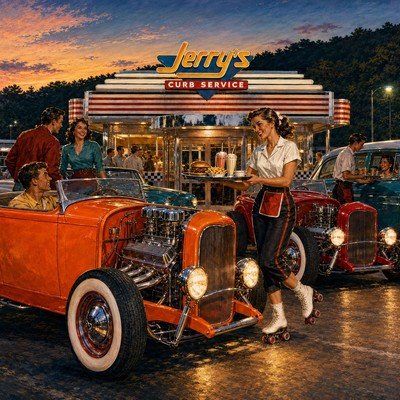
Drive-ins became car culture’s living rooms. Jerry Reed opened Jerry’s Curb Service in Chippewa in 1947, later moving it to Riverside Drive in Bridgewater. Carhops delivered hamburgers, milkshakes, and eventually the Pittsburgh-style steak salad. The car was now transportation, dining room, music hall, and courting parlor. Detroit had not merely replaced the horse. It had replaced the front porch.
Drive-in theaters carried the arrangement further. The Hi-Way 51 in Chippewa, later the Super 51, held about 500 cars; Spotlight 88 in North Sewickley, roughly 600; and the ABC near Baden, around 700. The Tusca, Green Garden, and Kane Road served their own territories. Families brought children in pajamas. Teenagers selected parking places according to criteria having little to do with the screen. The automobile could now take you to the movies and permit you to ignore them in privacy.
Street racing accompanied all this, although the record is thin. People holding illegal midnight races rarely alerted the newspaper. Local racers often went to Quaker City Drag Strip, which opened north of Salem, Ohio, in 1957. Early races ran by headlight, a flagman started them, and $2 bought a chance at a trophy. Quaker City later attracted stars such as Don Garlits and Don “The Snake” Prudhomme while giving local drivers somewhere better than Darlington Road to test their mortality.
By the 1970s, gasoline prices, insurance rates, emissions rules, police, and dying downtowns wore down the old cruising loop. But Beaver County car culture did not disappear.
It acquired permits.
Corvettes of Pennsylvania was founded at Brady’s Run Park in 1971 and remains active more than half a century later—friends who happen to own Corvettes, which sounds better than admitting they joined a support group for people who polish fiberglass.
The modern organized cruise began in 1985, when WBVP and WWKS held a gathering at Hank’s on Junction Stretch. Hundreds of cars circled the lot to oldies, without judging or trophies. It was the old ritual with radio promotion and better liability coverage.
In 1990, the Happy Days Car Club attracted about 100 cars to the Big Beaver Falls Area High School parking lot. That gathering became the Beaver Falls Car Cruise, now filling Seventh Avenue with several thousand vehicles. Beaver’s Hot Summer Nights followed, drawing more than 2,000 cars and tens of thousands of spectators to Third Street. The popular cruise at The Willows became another fixture on the summer calendar. Soon Rochester and New Brighton had events, too, and weekly cruises appeared wherever a restaurant, fire hall, veterans’ club, or shopping center possessed enough asphalt to accommodate Detroit’s accumulated output.
The modern cruise runs more smoothly than its ancestor. Streets close. Committees meet. Sponsors hang banners. Someone sells T-shirts; someone else worries about portable toilets.
But the ritual remains. Owners raise their hoods and await questions. Oldies play. People argue amiably about engines. Children peer into cars their grandparents once drove badly.
The cars survived because they were never merely machines. They were first dates, Friday nights, mill paychecks, freedom from parents, and proof that a patient man could make something faster, louder, shinier, and entirely his own.
That is how the kandy-kolored tangerine-flake streamline baby came to Beaver County.
It never left because we kept giving it somewhere to park.
Embrace early fall in Beaver County with aimless drives, fresh cider, and unexpected discoveries. Adventure awaits just beyond your familiar routes.
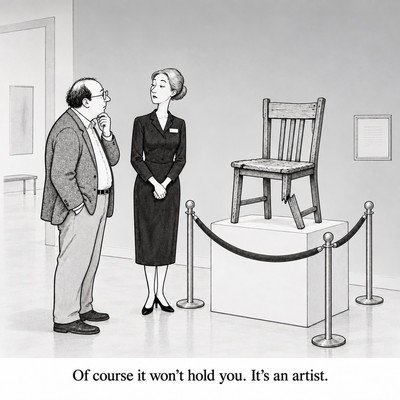
Art’s evolution from craftsmanship to the realm of theory raises questions about value and authenticity, blurring the line between creator and critic.