The Village You Just Drove Through
Rowetown’s history is a tapestry of community life, where ordinary intersections held significance, now faded yet vital to understanding our past.



Rodger Morrow
Editor & Publisher, Beaver County Business
When I was growing up on our farm in Chippewa Township, coyotes belonged out West, along with tumbleweeds, stagecoaches, and men who settled disagreements before the sheriff arrived. On Morrow Road, we had foxes. A fox was quite enough. Nobody looked across the pasture and said what this place needed was a larger predator with a complicated family history.
The coyotes came anyway.
They did not arrive through an economic development initiative. Nobody offered them a tax abatement, built an access road, or promised that their presence would create several hundred permanent jobs. They walked here. In a county accustomed to waiting for somebody to announce the next big thing, this was an unusually direct approach.
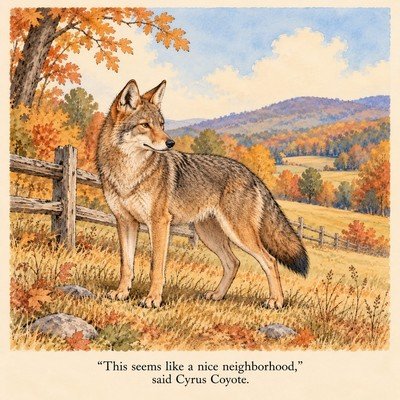
The journey began with what Americans considered an improvement. We removed wolves from much of the East. Wolves ate livestock, frightened people, and declined to recognize property lines. Through bounties, poison, and other vigorous expressions of disapproval, we cleared the neighborhood of predators that had helped keep coyotes in their western territory. We cut down much of the forest, too, which suited an animal from open country. We had solved the wolf problem. We had also advertised a vacancy.
Coyotes expanded east by two broad routes. One passed south of the Great Lakes, through country including Indiana and Ohio. The other went north through Ontario, where surviving wolves became part of the story. Coyotes and wolves can produce fertile offspring, and some did. Their descendants continued east and south, bringing wolf ancestry into the Northeast. The two streams eventually met in western New York and Pennsylvania.
The northern travelers grew sturdier than the lean western coyote. Wolf ancestry helped furnish a larger frame and skull, useful equipment in country where dinner might involve a deer rather than a mouse. It did not make the coyote a wolf, but it widened the menu.
Pennsylvania’s records of their arrival are incomplete. The Game Commission identifies a Tioga County animal killed in 1940 as the first resembling today’s eastern coyote. A larger influx came into northern Pennsylvania from New York’s Catskills in the late 1960s, then spread south and west. By 1990, the commission says, coyotes occupied the entire state. That helps explain why the farm of my childhood had foxes, while Beaver County today has another animal to discuss over coffee.
There is no need to pretend we know the date the first one crossed the Beaver County line. Wild animals seldom stop to have their picture taken beside the welcome sign. Our proximity to Ohio puts us near the southern approach, which scientists once believed had stayed free of wolf ancestry. It had not.
A widely cited genetic study published in 2014 found that every northeastern coyote it sampled carried a mixture of coyote, wolf, and domestic dog ancestry. The Ohio animals were no exception. On average, the coyotes were about one-tenth dog. The percentages vary among animals and places; they are not a recipe stamped on every Beaver County coyote. The
important point is that this newcomer brought an extended family. Somewhere back in the pedigree, a domestic dog contributed without leaving a forwarding address.
This makes “coydog” understandable as neighborhood vocabulary, though misleading if it suggests last summer’s romance between a coyote and somebody’s wandering Labrador. The dog ancestry generally reflects older interbreeding. “Eastern coyote” remains a perfectly serviceable name. An animal should not need a genealogist before we can mention it.
Nor is every deer in its diet evidence of a successful hunt. Coyotes scavenge, including deer killed on highways. They also eat rodents, rabbits, insects, and fruit. They have adapted to woods, farms, and suburban edges, which makes Beaver County a reasonable place to settle. We provide cover, groceries, and considerable disagreement about the neighbors.
None of this makes a coyote a welcome companion for an outdoor cat or unattended small dog. Admiring an animal’s resourcefulness does not require inviting it to inspect the pets.
Still, there is something instructive about its arrival. We removed the wolves and assumed the matter was closed. A smaller relative found the opening, picked up a little wolf along the way, and moved in.
Apparently, nature had not received our final report.
Rowetown’s history is a tapestry of community life, where ordinary intersections held significance, now faded yet vital to understanding our past.
This October, embrace the journey. Discover the hidden stories in the landscape as you make your way to the pumpkin patch. There’s more than meets the eye.