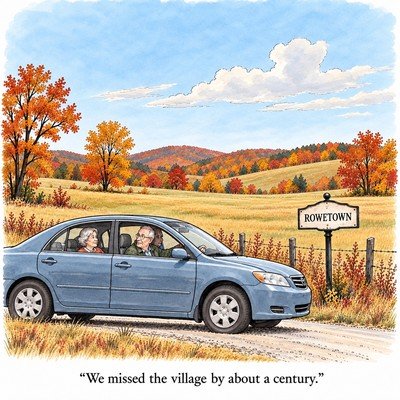
The Village You Just Drove Through
Rowetown’s history is a tapestry of community life, where ordinary intersections held significance, now faded yet vital to understanding our past.



GrandPa Jim
Curmudgeon in Residence
There was a time when a child could get acquainted with nature without being told he had about eleven years to save it. In those days you started with a rabbit. The rabbit was nosy and often foolish, and he could not leave alone anything that was none of his business. This made him excellent preparation for wildlife, and for borough council.
The rabbit was Peter, and his landlord was Thornton Burgess.
Burgess rented the Green Meadows, the Smiling Pool, and the Dear Old Briar Patch to tenants with steady habits and very human troubles. Reddy Fox was clever. Jimmy Skunk understood the value of being left alone, and so did everyone who had met him. Sammy Jay had opinions and saw no reason to keep them to himself. A child who knew these animals was ready for Thanksgiving with the relatives.
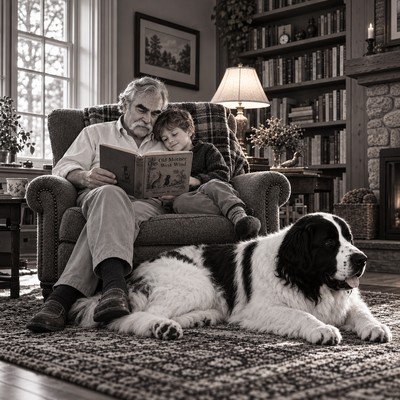
I got to thinking about Burgess after reading Rodger Morrow’s column about the coyotes that have moved into Beaver County without asking anybody. The drawing that ran with his piece introduced Cyrus Coyote. He is a solid citizen looking over the neighborhood with the air of a man who has already decided where the sofa goes. Cyrus comes from the old storybook line, in which an animal could have a personality without needing batteries.
Burgess was born in Sandwich, Massachusetts, in 1874. His father died while he was an infant, and his boyhood mixed work with long rambles through the fields and marshes that later furnished his imaginary world. As a grown man he began writing stories for his young son, whose mother had died. He mailed them to the boy while he was away visiting his grandmother. Old Mother West Wind came out in 1910.
That is a modest way to start a publishing empire: a father trying to give one small boy something to look forward to in the mail.
The empire did not stay modest. From 1912 to 1960, Burgess wrote a syndicated newspaper feature called Bedtime Stories. Over his life he turned out more than 170 books and somewhere around 15,000 newspaper stories. I write one column at a time and count each one a personal victory over sloth. I take his figure less as an achievement than as an accusation.
His great advantage was that the reader already knew the neighborhood. Nobody spent six pages on Peter Rabbit’s unresolved feelings about being a rabbit. Peter was a rabbit. He wanted to know something he would have been happier not knowing. Reddy Fox was in the vicinity. Events took their course.
The stories suited a grown-up reading aloud and a child steadily losing consciousness. Familiar names, familiar places, and adventures of manageable size promised that the Smiling Pool would still be there in the morning. If the child fell asleep, the bedtime story had done its job. Nobody expected him to wake up with a marketable skill.
There were lessons, of course. Vanity, laziness, and lying usually spoiled some animal’s afternoon. But the lessons arrived by way of somebody else’s misfortune, which is still the only pleasant way to be taught anything.
Harrison Cady’s drawings made the whole community look settled and respectable. The animals wore waistcoats, but you could still tell they were animals. The clothes suggested that even a woodchuck ought to make an effort before going out in public. The rest of us have since retreated from that standard, in sweatpants.
Purists will object. Foxes do not spend their days administering gentle moral corrections to rabbits. A real briar patch has fewer conversations and more sudden endings. Burgess’s woods were arranged for children, and the rougher business was handled offstage.
At bedtime I am not sure this was a serious defect.
Nor was putting children to sleep his whole ambition. Burgess campaigned for conservation, and he used his clubs and radio broadcasts to urge protection of wildlife and the places it lived. The talking animals were a way of introducing children to creatures whose real homes mattered.
That, it seems to me, was the lasting genius of the business. It is hard to care about a place you have never noticed. Give a child a reason to look at a pond, and the pond stops being merely the wet part of the scenery.
Why he faded from the bookshelf is no mystery. Repetition can harden into formula, and the familiar can turn quaint. Television offered animals that moved. Later devices offered animals that wanted passwords. The quiet voice beside the bed found itself in a crowded market.
Here in Beaver County, we still have creeks, woods, rabbits, and enough opinionated birds to staff a borough council. The neighborhood Burgess introduced is still there, waiting for somebody to point it out to a child.
The waistcoats are optional.
Rowetown’s history is a tapestry of community life, where ordinary intersections held significance, now faded yet vital to understanding our past.
This October, embrace the journey. Discover the hidden stories in the landscape as you make your way to the pumpkin patch. There’s more than meets the eye.