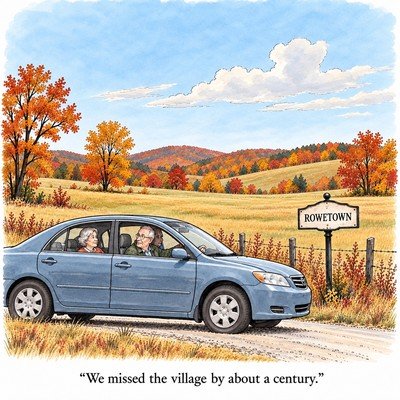
The Village You Just Drove Through
Rowetown’s history is a tapestry of community life, where ordinary intersections held significance, now faded yet vital to understanding our past.



Rodger Morrow
Editor & Publisher, Beaver County Business
Politics used to fail in a masculine key. The room was sure of itself, the enemy was a cartoon, and warnings were meant for smaller men. The plan went forward because nobody wanted to be the fellow who spoiled a confident meeting. In his 1972 book, Victims of Groupthink, Irving Janis examined disasters including the Bay of Pigs invasion, the failure to prepare for Pearl Harbor, and the escalation in Vietnam. The rooms were full of powerful men. Their confidence survived considerably longer than their judgment.
The newer failure speaks with a different accent. It seems less interested in winning an argument than in keeping everyone properly affiliated. The question becomes whether the plan preserves the circle, and whether doubting it makes you a bad person. That is what I mean by the feminization of politics. Women holding office are not the issue. I mean the spread of a style traditionally associated with feminine social expectations, in which maintaining the relationship becomes the highest constituency.
You can hear it in the way positions are defended. A policy is no longer merely argued for; it is cared about. Immigration, the classroom, the wording on a form, the last weeks of a pregnancy: each arrives already wearing a moral sweater. Ask what the thing costs, who pays, or what happens in the second year, and you have let a draft into the room. In Beaver County, asking who pays ought to count as a local custom. Someone generally has the tax bill handy. Yet silence counts as agreement. Someone stands at the door and decides which facts are kind enough to come in. Janis called such people “mindguards.” Nowadays, the job sometimes travels under the more flattering title of ally.
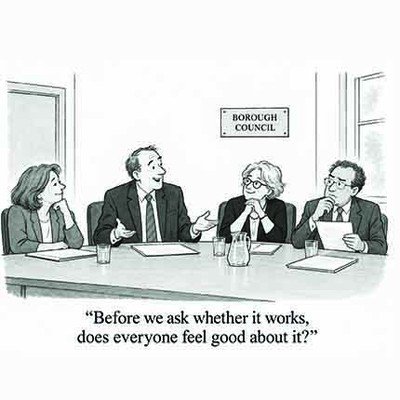
None of this requires a female majority. It requires a politics that rewards being seen to agree. Social media provides the machinery: approval is public, dissent attracts a crowd, and everyone can inspect everyone else’s affiliations. Exclusion once meant a cold look across the table. Now it can follow you home and continue through breakfast. The room never adjourns.
Psychologists have a word for excessive dependence on approval and acceptance: sociotropy. Aaron Beck’s Sociotropy–Autonomy Scale includes concerns that sound remarkably familiar— censoring yourself to avoid disapproval, searching for signs that you are welcome, and pleasing others at your own expense. Some studies have found higher average sociotropy scores among women. That does not establish that women are less capable of independent judgment, much less explain the behavior of an electorate. It does suggest why a political culture organized around acceptance might be described as feminine.
Men, of course, scarcely need instruction in conformity. They practice it in barracks, boardrooms, and trading rooms, where it generally goes by the name of being a team player. Beaver County did not require the invention of Facebook to discover that disagreeing with the fellows could complicate your afternoon. Janis’s men were protecting their circle, too. The machinery is old. What interests me is the change in its public vocabulary: loyalty increasingly presents itself as care, and disagreement becomes an offense against the relationship.
The old room asked whether you were man enough to go along. The new one asks whether you are kind enough.
Either way, somebody ought to ask whether the plan works.
Rowetown’s history is a tapestry of community life, where ordinary intersections held significance, now faded yet vital to understanding our past.
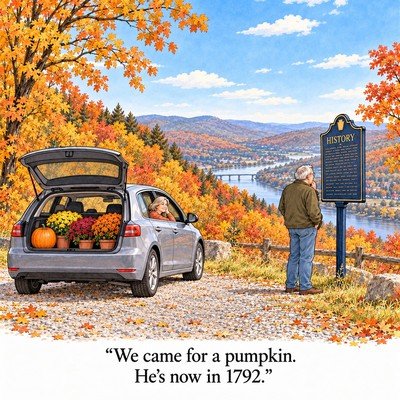
This October, embrace the journey. Discover the hidden stories in the landscape as you make your way to the pumpkin patch. There’s more than meets the eye.