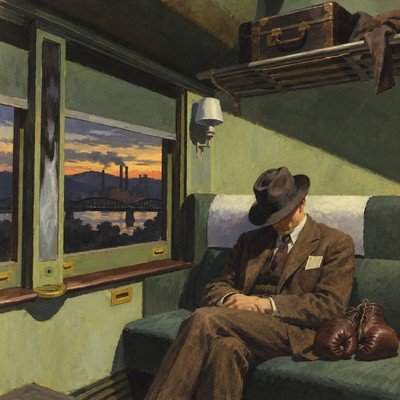
Sig Keppen: A Fighter by His Trade
Sig Keppen was a fighter in the 1920s, embodying the spirit of resilience and courage as he faced opponents in the ring, one bout at a time.

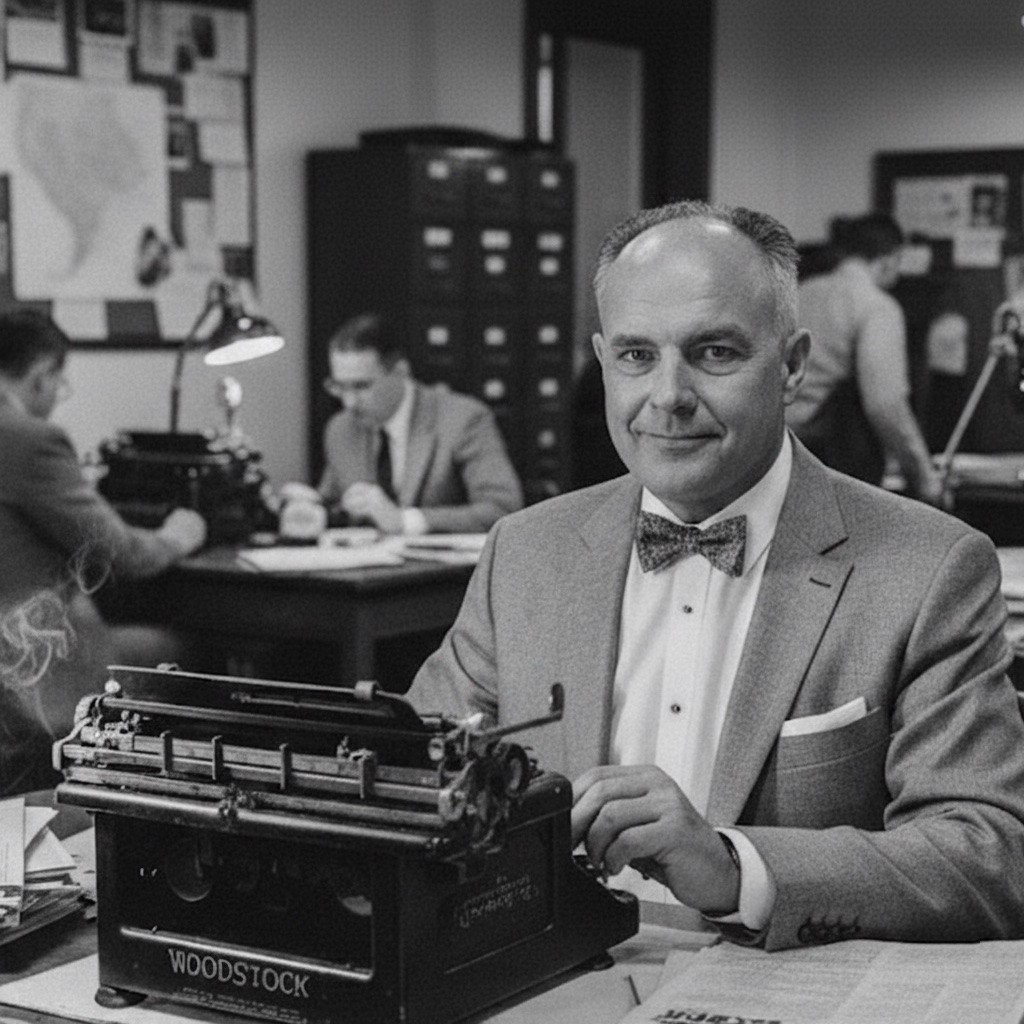

Rodger Morrow
Editor & Publisher, Beaver County Business
Beaver County is bracing for an AI building boom. Apple is betting that a good part of the future fits in your pocket.
By Rodger Morrow, Editor & Publisher Beaver County Almanac
If every artificial-intelligence data center proposed for Pennsylvania gets built, we may have to move Pennsylvania somewhere else to make room.
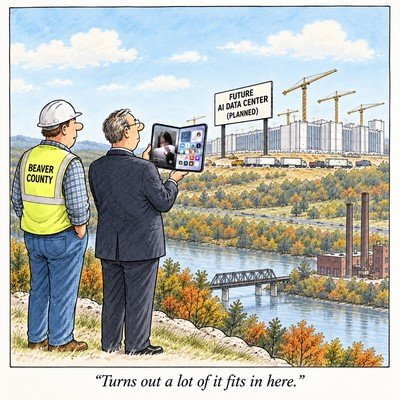
The Commonwealth now knows of at least 100 proposals. In Beaver County, developers have been eyeing the acreage the old industrial economy left behind: the former Bruce Mansfield power plant at Shippingport, the old Pittsburgh International Race Complex in Big Beaver, and the J&L land around Aliquippa.
The numbers attached to these projects are the kind usually found in federal budgets and Powerball drawings. Switch has proposed a campus of roughly 400 acres in Big Beaver, with three enormous buildings. At Shippingport, plans for the Mansfield site include a data-center campus with its own behind-the-meter power supply.
Some of this may get built. I would not order the commemorative plaque just yet.
An argument is taking shape that the great data-center boom may leave behind fewer data centers than the brochures promise. The fellow making it isn’t broadcasting from his basement. It’s Apple.
Microsoft, Amazon, Google, and Meta are expected to spend $725 billion on capital projects this year, much of it for artificial intelligence. The reasoning is simple enough. AI needs gigantic computing power. Gigantic computing power needs gigantic buildings. Therefore, whoever owns the most gigantic buildings, stuffed with the most gigantic quantities of very expensive chips, wins.
This is how technology booms usually begin. Everyone discovers the future at the same moment, and everyone starts pouring concrete.
Apple has been conspicuously slow to pour.
Most people took this to mean Apple had fallen behind, and there is plenty of evidence for that. It promised a much smarter Siri, failed to deliver it on time, and finally went to Google for help.
But Apple has now shipped the rebuilt Siri, which runs partly on the phone and partly in the cloud. And this month it handed the chief executive’s office to John Ternus, its longtime hardware chief.
That is worth pondering in Beaver County. Apple is betting that the future of artificial intelligence will not live entirely in windowless buildings next to power plants.
Some of it will live in your pocket.
For nearly two decades, Apple has been putting ever more powerful chips into iPhones, iPads, and Macs. Instead of shipping every AI request hundreds of miles to a server farm, it can do some of the work on a machine the customer has already bought.
That is not merely a technical distinction. It is an economic one.
A cloud AI system requires somebody to build the building, buy the chips, secure the electricity, cool the equipment, and keep the servers running. Then somebody has to pay the bill every time a few million people ask the machine to write a resignation letter or rule on the leftover chicken.
The iPhone is different. The customer bought the computer. Better yet, from Apple’s point of view, the customer carries it around all day and pays for its electricity at night.
None of this means data centers are going away. The most sophisticated models need enormous centralized computing power, and Apple’s own system still leans on the cloud. The building boom is answering real demand.
But technology has an inconvenient habit of getting more efficient.
Models shrink. Chips get faster. Software gets better at deciding which jobs need a supercomputer and which can be done at home. Anthropic, for one, just announced a top-of-the-line Claude model it says costs substantially less to run without giving up performance. The computing it takes to produce a given amount of intelligence is not fixed forever.
That matters when somebody proposes a billion-dollar building meant to run for decades. Today’s forecasts mostly project today’s computing needs into tomorrow. If AI follows the history of nearly every computing technology before it, tomorrow’s machine will do more with less.
Remember the computer room? Businesses once gave entire rooms to mainframes that a wristwatch would now find embarrassing. Then came the minicomputer, the desktop, the laptop, the smartphone, and the cloud. For 70 years, computing has swung between the big central machine and the small one close at hand.
AI may swing the same way.
That is why Beaver County should keep a healthy skepticism.
The state says that of the 100-plus data centers it knows about, the great majority have not formally approached it about permits or taken any meaningful step toward construction. That is a remarkable gap between proposed and real.
We have seen this movie before. In every boom, projects multiply faster on PowerPoint than on Pennsylvania soil. A developer finds acreage. Another finds electricity. Somebody announces billions in potential investment. Renderings appear, showing immaculate buildings surrounded by suspiciously healthy trees.
Then economics gets a vote.
Power prices change. Financing changes. Demand changes. The chips get more efficient, the models get cheaper, and a competitor discovers it can do the same job with half the capital.
And the artist’s rendering goes quietly home to the artist.
None of this is an argument against welcoming serious data-center investment. Shippingport, in particular, has something many speculative projects lack: an industrial site actively being redeveloped around substantial energy infrastructure. County Commissioner Jack Manning said in April that Bruce Mansfield was the one local data- center project he knew to be “active and ongoing.”
That is a good deal more than a pin on a map.
But the county should learn to tell projects from proposals, proposals from possibilities, and possibilities from publicity.
The AI revolution is real. The investment is real. The demand for computing is real. What nobody knows is how much of the infrastructure proposed today will still be needed ten years from now.
For the moment, Beaver County is looking at hundreds of acres and billions of dollars and trying to imagine the future.
Apple is looking at the same future and betting that an astonishing amount of it can be squeezed into something you can lose between the sofa cushions.
That may turn out to be pocket change in more ways than one.
Sig Keppen was a fighter in the 1920s, embodying the spirit of resilience and courage as he faced opponents in the ring, one bout at a time.
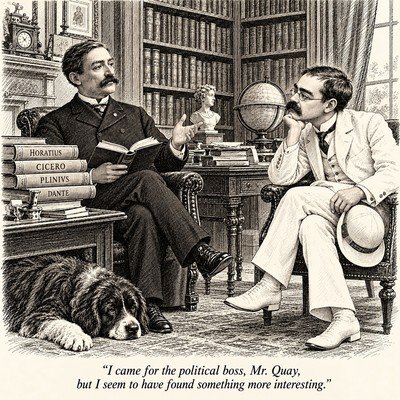
Matthew Stanley Quay was a powerful political boss, but his true passion lay in literature and knowledge, revealing a complex legacy beyond politics.