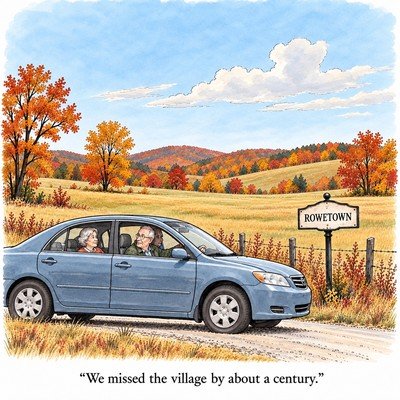
The Village You Just Drove Through
Rowetown’s history is a tapestry of community life, where ordinary intersections held significance, now faded yet vital to understanding our past.



Rodger Morrow
Editor & Publisher, Beaver County Business
Everybody in Beaver County has an opinion about the Shell Polymers plant, and most show up fully dressed and ready to argue. The plant brought hundreds of permanent jobs, though a county that remembers steel can be forgiven for wishing there were more. It has also accumulated a documented record of air-quality violations. A county that spent a century living next to industry has earned the right to count both the paychecks and the plumes.
Neither ledger should be closed. Shell originally projected about 600 permanent employees and now reports roughly that many associates. The environmental record is less reassuring. In September, Pennsylvania’s Department of Environmental Protection announced a $15 million settlement covering violations from 2023 through August 2026, following a nearly $10 million agreement in 2023. Those are substantial entries in anybody’s bookkeeping.
Still, another question deserves more attention. The plant produces a conspicuous amount of light after dark, and the ordinary lighting remains a neighborhood concern apart from whatever happens on the production line.
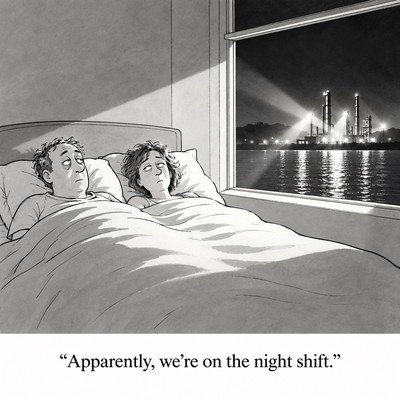
Light is part of the plant’s ordinary condition.
Drive down the Ohio after dark and the complex looks like a small city that’s forgotten how to sleep. Towers, pipe racks, and parking lots are lit as if somebody feared the night might sneak in and spoil the product. The glow sits on the river like a second moon that took the civil- service exam and passed.
We’ve gotten into the habit of treating darkness as a vacancy, like an empty lot waiting for a Sheetz. It isn’t. It’s a working part of the county. Nobody needs to pretend the old industrial valley was a wilderness preserve. The mills had lights, too, along with enough smoke to make stargazing an uncertain hobby. But the fact that our grandparents endured something doesn’t oblige us to order another helping.
Light doesn’t necessarily stay inside a fence. It can spill into neighboring properties and scatter in the atmosphere, brightening the sky beyond its intended destination. A plant needs to illuminate the places where people work. Whether all the light visible from surrounding neighborhoods serves that purpose is a reasonable question.
Biologists have been studying the consequences of artificial light at night for years. It can disorient migrating birds, attract insects, and alter the behavior of nocturnal animals. An insect may treat a lamp like a nightclub with no closing time. The general risks are established; the effects of this particular plant need investigation. We shouldn’t invent a wildlife casualty report because the view looks bright.
There’s a human question, too. Light helps set the body’s clock, and exposure at the wrong hour can interfere with sleep. That doesn’t establish what reaches anybody’s bedroom from Shell, or what happens afterward. It does justify asking. A glow visible from the porch is reason to take measurements, even if it isn’t, by itself, a medical finding.
We also need to distinguish ordinary electric lighting from flaring. Shell describes its flares as safety and emissions-control equipment. A flare can dramatically brighten the sky, but shielding a parking-lot lamp won’t fix it. Different sources of light require different questions.
Fortunately, we needn’t begin with a blank sheet. Shell says it submitted a proposed lighting plan to Potter Township with its conditional-use application in 2016, incorporating community feedback and occupational safety requirements.
A decade later, the neighbors deserve to see how that plan performs.
Shell should make the original plan and any revisions readily accessible, explain what must remain illuminated for safety, and provide measurements showing what reaches beyond the property. Where could fixtures be shielded or redirected? Where might lower intensity or warmer lamps work? Those are established approaches to reducing unwanted light, though their suitability inside this plant requires engineering judgment.
Supervisors in Potter and Center townships, and council members along the river, should ask for those answers in writing. Residents troubled by the glow should describe where and when they see it, rather than having to choose between saying nothing and demanding the plant disappear.
The county has spent generations learning to live with industry. Industry can keep learning to live with the county. A lighting plan filed before construction is a starting point for that conversation, not its final word.
Dark-sky shielding isn’t a protest. It’s maintenance.
Rowetown’s history is a tapestry of community life, where ordinary intersections held significance, now faded yet vital to understanding our past.
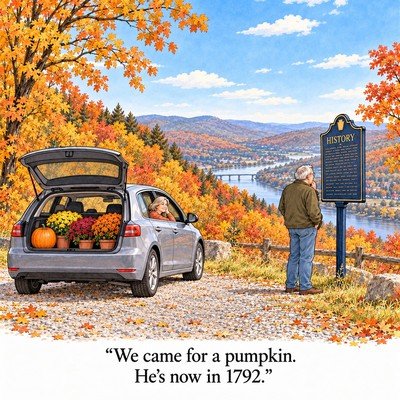
This October, embrace the journey. Discover the hidden stories in the landscape as you make your way to the pumpkin patch. There’s more than meets the eye.