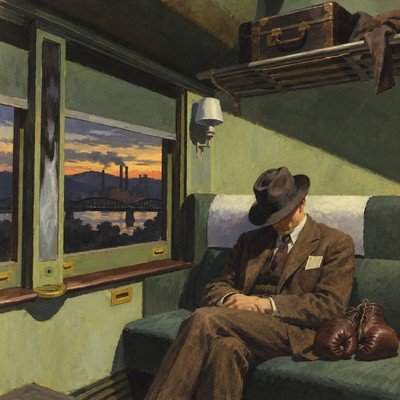
Sig Keppen: A Fighter by His Trade
Sig Keppen was a fighter in the 1920s, embodying the spirit of resilience and courage as he faced opponents in the ring, one bout at a time.



Rodger Morrow
Editor & Publisher, Beaver County Business
There was a time when a young woman who slept with the wrong man could damage the marriage prospects of every girl on the block. Not because the neighbors were prudes, and not because heaven kept a ledger of bedrooms. Arthur Schopenhauer had another explanation. Women, he said, had discovered that restraint was leverage.
Schopenhauer, the German philosopher who regarded human happiness as a clerical error, called the arrangement “sexual honor.” He did not mean that women were more virtuous than men. He meant something closer to the opposite: that sex was a bargaining chip, and women had learned to play it together.
The theory runs roughly like this. A woman bears the cost of pregnancy and has the most to lose when a man won’t stay and provide. A man has always had an incentive to get sex without signing up for the rest. So women, as a body, withheld sex outside marriage. If enough of them held the line, a man who wanted a sex life had to take the whole package: commitment, provision, protection, and a family.
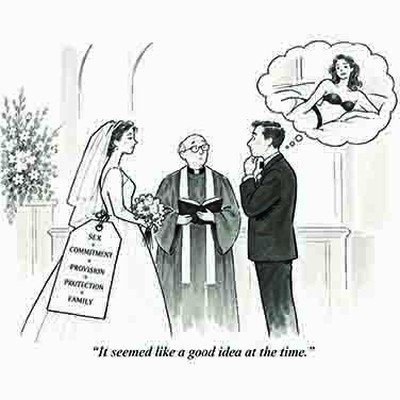
This was not holiness. It was not romance. It was collective bargaining—a labor union with better lingerie.
And it worked, until it didn’t.
You can understand the old bargain better in Beaver County than in most philosophy departments. For generations, a young man here was expected to get a job, preferably a good one—in the mill, on the railroad, in a machine shop, or at one of the hundreds of small businesses that kept the river towns humming. Then he bought a car. Then, if things went according to plan, a house. Then came marriage, then children, then thirty years of complaining about the furnace.
It wasn’t always bliss. Plenty of local marriages ran on love, loyalty, and the shared understanding that a divorce would have to be explained to Aunt Helen. But everybody knew the terms. The man became responsible for something larger than himself. The woman made the home that gave the responsibility its meaning. Children belonged to a family, not merely to two adults who happened to share some DNA.
Nobody called this a mating strategy.
They called it getting married.
Schopenhauer looked at the same arrangement and saw the machinery underneath. What interested him was not that women were virtuous but that women collectively had an interest in a rule that each of them, individually, had some reason to break. Suppose most women insist that sex requires commitment. Then a man who wants sex must offer commitment. Now suppose one woman offers it without. She may gain something. The
man certainly does. And every other woman loses a little leverage because the man now has an alternative.
That is why, in Schopenhauer’s model, the woman who broke the rule was not making a purely private decision—and why the rule was enforced by gossip, shame, and the neighbors. You needn’t accept the analysis to see what makes it uncomfortable. He wasn’t saying women should be chaste because men deserve chastity. He was saying chastity had consequences, and that they were economic, social, and transactional.
We have spent decades assuming that anything transactional must be morally inferior. But civilization runs on transactions; we just give them nicer names. A contract is one. A mortgage is one. Marriage, whatever Hallmark says, is a bundle of them: I’ll stay; you’ll stay; we’ll raise these children, pay this mortgage, take turns being sick, tolerate each other’s relatives, and one of us will eventually find out why the washing machine is making that noise.
The old bargain tied all of that together.
Then we started pulling it apart.
Contraception separated sex from pregnancy. Women’s earning power made marriage less of an economic necessity. Divorce got easier. Premarital sex became ordinary. Dating moved onto phones, and pornography onto everything. The old rule—commitment first, then sex—lost most of its force.
If a man can get sex without commitment, his reason to commit shrinks. If a woman can support herself, her reason to accept a bad marriage shrinks. Both are gains in freedom. Both loosen the knot that once tied sex, marriage, and money together. A young person can now survey more potential partners in ten minutes on a phone than his grandparents met in ten years of church, work, school dances, and the county fair.
We gained freedom.
Freedom changed the rules.
Here the modern argument over Schopenhauer gets complicated. One camp says men looked at the collapse of the old bargain and decided marriage wasn’t worth it. There’s something to that. Another says many men didn’t withdraw so much as lose—that the old route to being desirable stopped paying.
In the old days, a man didn’t need to be handsome, charming, or exciting. He could be reliable. He could show up for work, fix things, save money, buy a modest house in Chippewa or Beaver Falls, and come home every night.
He became valuable by investing.
Today, looks, status, money, visibility, and the sheer luck of digital exposure count for more than they used to. That doesn’t make women cruel, and it doesn’t entitle men to anything. It means the incentives changed, and people who did well under the old rules don’t necessarily do well under the new ones.
That is where Schopenhauer is useful without being right about everything. He understood that you can’t pull one thread without tugging the others. If sex no longer requires commitment, commitment is no longer the price of sex. If marriage is no longer necessary for survival, it survives only if people want it for its own sake. If divorce is easy, “forever” becomes a figure of speech.
None of these changes is necessarily bad. Each changes the arithmetic, and arithmetic was what Schopenhauer cared about.
That makes him more useful than the usual internet argument over whether men or women are to blame. Nobody invented loneliness, sexual competition, or the desire to be wanted. We have simply built a world in which the old machinery for turning desire into commitment runs a good deal weaker.
The consequences don’t stay in the bedroom.
They reach the children.
For most of history, sex, marriage, and children came bound together, and marriage answered the question of who was responsible for whom. Schopenhauer saw fidelity serving another purpose: a man who trusted his wife could trust that her children were his. In his telling, this wasn’t sentiment. It was economics. A man invests more heavily in children he believes are his own—a point evolutionary psychologists would make again more than a century later.
We have since learned that biology isn’t the whole story. Adoptive parents, stepparents, and families built through assisted reproduction prove it every day. But the old incentive doesn’t vanish because we stop mentioning it. Neither does a child’s need for stability.
Children don’t care about our theories of sexual liberation. They want somebody to show up. They want somebody who knows where their shoes are, who comes to the school play, who is there when the world turns frightening.
Adults want much the same. Women still want security. Men still want affection. Both want fidelity, and someone to trust when the furnace quits in January. The difference is that we now expect those things to materialize without the social structures that once helped produce them.
That is a large assumption.
Then there is restraint, the idea hardest on modern ears. Schopenhauer’s bargain depended on it because the system couldn’t survive everyone chasing immediate advantage. It’s a familiar problem in economics: what is rational for one person can be ruinous when everyone does it.
So the old system required people to say no to things they wanted.
That sounds positively medieval.
Yet every durable institution runs on restraint. A bank account works because you don’t spend it all today. A marriage works because you don’t treat every attractive stranger as an invitation to renegotiate. A community works because people sometimes help neighbors who can’t repay them.
Restraint isn’t necessarily oppression.
Sometimes it’s just the price of having something tomorrow.
None of this means we should resurrect the 1950s. I have lived long enough to know that the 1950s had plenty of problems without our inventing new ones for nostalgia’s sake. There were unhappy marriages, women trapped by dependence, men who drank themselves insensible after a shift, and children who learned early that the dinner table was not always a peaceful place. The rules about sex could be cruel, and they were often hypocritical.
But we shouldn’t mistake the old system’s failures for a lack of useful parts.
That’s the part of Schopenhauer worth rescuing.
He wasn’t telling us how to be good. He was asking what made the machine run. It’s a fair question in Beaver County, where we have spent most of a century watching systems disappear. The mills went. The mines went. So did the trolley lines, the corner grocery, and the newspaper on too many front porches. So did the notion that a boy could hire on at 18 and retire from the same company at 65, which you now have to explain to a 25- year-old as if it were a folk tale.
We know what happens when the supports go. The building doesn’t fall down right away. People keep living in it for years.
Then one day somebody notices the ceiling sagging.
Maybe sexual honor was one of those beams.
Maybe not.
Schopenhauer’s mistake, if he made one, was assuming human beings could be reduced to a single bargain. We’re messier than that. Biology matters, and so do economics, culture, religion, temperament, and luck. Evolutionary psychology may explain some recurring differences between men and women in attraction, jealousy, and parental investment, but it describes tendencies, not commandments. It can’t tell us what kind of society to build.
Schopenhauer’s theory is better read as an account of incentives and institutions than as a law of female nature. But incentives matter, and we ought to be honest about the ones we’ve created. We have given men and women more freedom than any generation before them could have imagined.
The harder part is deciding what to build with it.
Not the old bargain restored.
A better one.
It would begin with consent and equality but not stop there. It would let people leave abuse without treating every inconvenience as oppression. It would take sex seriously without treating women as property or men as wallets. And it would ask both partners to bring something that lasts—honesty, fidelity, self-command, and a willingness to carry the load after the excitement fades.
Children would be at the center, not as an argument against adult freedom but as people who need dependable adults and promises that outlast a mood. Marriage would be neither prison nor prize, but a public promise to organize private desire around shared work and the long future of a family.
Much of the old machinery deserved to go.
What we haven’t built is anything that reliably produces commitment without coercion, responsibility without dependence, or stability without hypocrisy.
The terms of the new bargain ought to be simple enough to remember and hard enough to matter: Nobody is owed sex, marriage, or permanence. But anybody who wants the benefits of intimacy had better be ready to offer trust, sacrifice, and responsibility in return.
Freedom is wonderful.
But sooner or later, somebody has to build the house.
Sig Keppen was a fighter in the 1920s, embodying the spirit of resilience and courage as he faced opponents in the ring, one bout at a time.
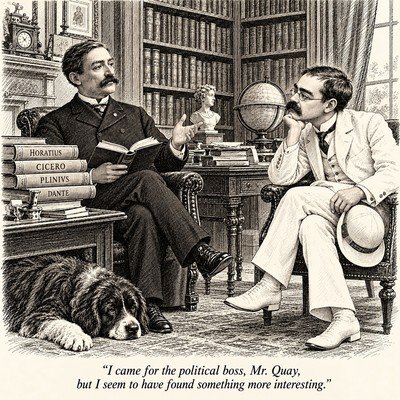
Matthew Stanley Quay was a powerful political boss, but his true passion lay in literature and knowledge, revealing a complex legacy beyond politics.